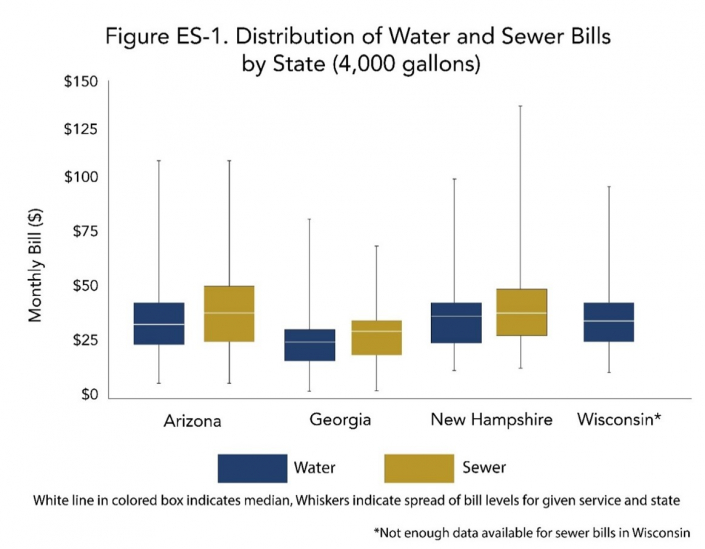
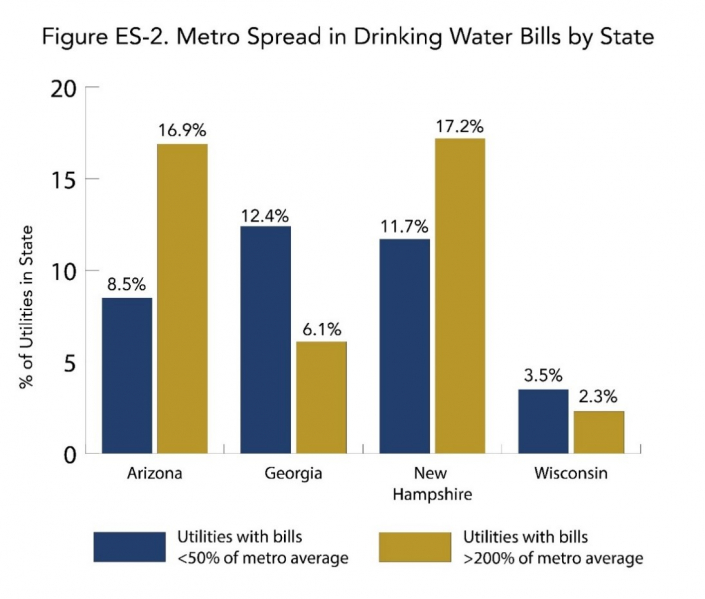
Understanding variation in water bill levels is important in the context of affordability and environmental justice efforts. Notably, substantial disparities in water bill levels motivate consideration of policy options for systems with extreme bill levels, including (but not limited to) increased and equitably allocated federal and state water infrastructure funding, assistance to promote systems’ TMF capacity, potential consolidation, customer assistance and affordability programs, and equitable rate design guidance.
Growing recognition by regulators, policy makers and advocates of the financial obstacles to safe, reliable water access centers around three interrelated factors— 1) a water system’s TMF capacity, 2) the service population’s economic condition, and 3) customer level affordability. More importantly, there is also recognition that the results of these analyses need to be incorporated in water system needs assessment efforts.
Some of the variation in water bill levels seen across systems in this study can be explained by system ownership type, size, water source, rate structure, the bill levels of neighbors, race-ethnicity, income inequality of customers, and other characteristics. On the one hand, having neighboring systems with higher bills and using purchased water as the main water source are both strongly associated with having higher bill levels. On the other hand, municipal ownership type, larger service population, and a baseline monthly allowance of water are all associated with having lower bills, supporting hypotheses from existing studies. Increased income inequality and higher proportions of Non-White customers are also associated with having lower bills for systems, counter to the authors’ expectations, but these factors had relatively low explanatory power. Further exploration into the two-way relationship between a system’s customer demographics (beyond median household income) and water bill levels is essential.
Thus, while the study’s findings have implications for state and national water assessment efforts, the extent to which these results are generalizable across the U.S. is unclear. Collecting and analyzing bill data from more states will be essential to assess the generalizability of these results. Notwithstanding, this study fills a gap in the literature that compares bill levels across and within states and examines the factors that drive variation in water bill levels across state boundaries. As such, the findings of this study provide insight for further water system TMF and affordability policies and identify future research and data collection needs to make those efforts more robust.

 Selin Filiz, Sustainable LA Grand Challenge