
States across the U.S. have made historical investments in climate action, with a focus on programs that can achieve benefits in working-class communities. California, the state with the longest-standing effort to uplift frontline communities through climate investments, offers broad lessons, both what works and where changes are needed. Since 2014, the legislature has appropriated many billions of dollars in California Climate Investments for zero-emission transportation, sustainable communities, clean energy, natural resource conservation, and more.

The Luskin Center for Innovation is the leading academic research center evaluating and helping to inform equitable and effective California Climate Investments. One aim is to help California meet its goal to maximize benefits, particularly in underserved areas affected by pollution and poverty. Another aim is to take the lessons, both the strengths and the shortcomings, from California’s experience and use them to inform more transformative, community-driven investments across the nation.
CURRENT PROJECT(S)

Evaluation of Seven Transformative Climate Communities Program Investments

Researcher(s): Alex Aguirre Levitas, Samantha Astudillo, Camille Burrus, Elena Hernandez, and Jason Karpman
Funder: California Strategic Growth Council

Our team is documenting community-led, climate action that is funded by the Transformative Climate Communities (TCC) Program in seven communities: Fresno, Ontario, Pomona, South Stockton, and three Los Angeles neighborhoods (Northeast San Fernando Valley, South Los Angeles, and Watts). We are collecting and sharing data on measurable accomplishments as well as stories from residents, business owners, workers, and others who have shaped — or been shaped by TCC.

Learn more

PUBLISHED RESEARCH

Lessons from State Approaches to Climate and Clean Energy Investments

Author(s): Colleen Callahan, Daniel Coffee, J.R. DeShazo and Silvia R. González

This report provided a framework that federal officials could use to maximize Justice40’s impact. Drawing from analysis of state-level climate programs seeking to address environmental justice, the authors identify key areas of focus for the initiative: investing to provide resources for the people who need them most, empowering communities to make local policy and investment decisions, and holding government agencies and contractors accountable for furthering environmental justice goals.

Read the report

Author(s): Gregory Pierce and Rachel Connolly

This evaluation utilizes several datasets to track Valley Clean Air Now’s (Valley CAN) clean vehicle replacement program progress in the San Joaquin Valley (SJV) from October 2018 through June 2019, a time when Valley CAN was funded to accelerate the reach and pace of the Clean Cars 4 All program in the SJV. This initial assessment considers the impact on residents’ awareness, involvement, engagement, and vehicle acquisition. Even in this short period, we observe notable positive impacts.

Read the report

Author(s): J.R. DeShazo, Jason Karpman, Weilong (David) Kong, and Colleen Callahan

In the first-ever study of the statewide employment outcomes from California Climate Investments, the reseachers found that for every $1 million the state spends, 8.8 jobs are supported in California. This can be compared to 1.6 jobs for every $1 million invested in the oil and gas industries.

Read the report

Lessons Learned from the San Joaquin Valley and South Coast Air Districts’ First Year of Operation

Author(s): Gregory Pierce and J.R. DeShazo

This report describes lessons learned from the first year of the Enhanced Fleet Modernization Program Plus-Up pilot’s implementation in the San Joaquin Valley Air Pollution Control District and South Coast Air Quality Management District. The analysis supported a geographic expansion of this program, now called Clean Cars 4 All.

Read the report

Lessons from California’s Plug-in Electric Vehicle Rebate Program

Author(s): Tamara Sheldon, J.R. DeShazo, and Richard Carson

The researchers assessed the performance of alternative rebate designs for plug-in EVs and compared these alternatives in terms of cost-effectiveness and equity. The findings helped inform the adoption of California’s progressive rebate system in which low- and moderate-income drivers receive an additional $3,000 to $6,500 in financial incentives to purchase a clean vehicle, and limit program eligibility to households with less than $500,000 in annual income.

Read the paper

A Guide to Greenhouse Gas Reduction Fund Program Designs, Expenditures, and Benefits for Disadvantaged Communities

Author(s): Jeffrey L. Rabin, Colleen Callahan, and J.R. DeShazo

This report provides a guide to California Climate Investments, focusing on programs most targeted to benefit disadvantaged communities. The report provides an overview of each program and analyzes program investments based on recent funding levels before and after the establishment of the Greenhouse Gas Reduction Fund. Additionally, the authors recommend how to enhance investment benefits and put forth a framework to systematically assess program inputs, outputs, outcomes, and impacts.

Read the report

Implementing SB 535 and Advancing Climate Action in Disadvantaged Communities

Author(s): Colleen Callahan (see report for list of the many other contributors)

In 2012, Senate Bill 535 (de León) required that 25% of proceeds in the Greenhouse Gas Reduction Fund go to projects (now referred to as California Climate Investments) provide benefits to disadvantaged communities. The Luskin Center for Innovation organized a working summit (see below) and as an outcome produced a report that proposes a framework for planning and implementing California Climate Investments to help maximize benefits in communities affected by pollution and poverty.

Read the report

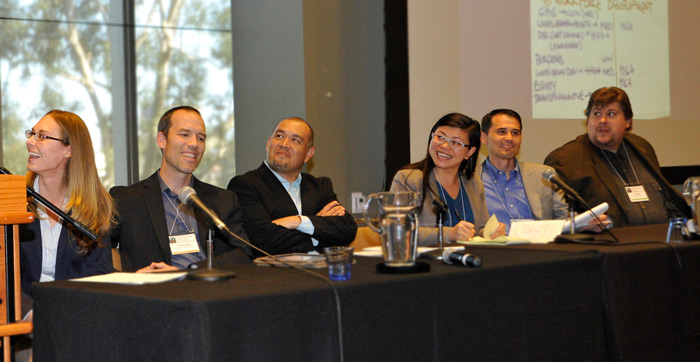
Government agency and climate equity leaders speak at an Investment Justice Workshop hosted by LCI.

Researcher(s): Colleen Callahan, with collaborators

In 2014, the Luskin Center for Innovation hosted the first major statewide gathering to inform implementation of California Climate Investments in disadvantaged communities. Nearly 200 government leaders, climate equity advocates, researchers, and executives of nonprofits and business associations participated in the working summit. Afterward, the Center co-hosted or participated in Los Angeles region and statewide climate equity convenings in collaboration with the California Climate Equity Coalition.

Read more