
Solar industry training provides a ladder to clean energy work opportunities energy work opportunities
BACKGROUND
This case study explores how TCC-funded job training at GRID Alternatives (see page 67 of this report) serves as a pipeline for the organization’s workforce while launching solar industry careers for Ontario residents. It highlights Nadia Sánchez and Francisco Javier Prats, two trainees who gained not only professional skills and financial stability, but also full-time employment at GRID. To learn more about Ontario Together’s workforce development programs, see page 56 of this report.
Interviews for this case study were conducted in July 2023 and January 2024.
FRANCISCO JAVIER PRATS moved to Ontario nearly 10 years ago. Before moving, he worked in construction, helping to build utility-scale solar plants in the desert. When the COVID-19 pandemic hit in March 2020, Prats was working in non-emergency medical transport. He was one of many who lost their jobs at the start of the pandemic. After being laid off, Prats found work at a warehouse in the region.
When Prats first heard about the paid job training program with GRID Alternatives (GRID), he thought it sounded too good to be true. He applied out of curiosity and began training in September of 2021. Near the end of his threemonth job training program, GRID offered Prats a full-time position. This training-to-employment process is not unusual for GRID; many of its employees started as trainees or interns. Prats says GRID also pays well — about $10 more per hour than he could make working in a warehouse, by his estimate. “The pay has been good,” he said. “We get an increase every year depending on inflation … [GRID] pays more than at regular warehouses, which employ, like, 70% of people in the Inland Empire.”
Even though he came into the job training program at GRID with experience, Prats has gained new skills by training and working at GRID Alternatives — especially electrical know-how. These skills, such as opening up service panels and removing breakers, are necessary for Prats’s current job and contribute to the foundation of expertise he will be able to utilize as he advances in his career at GRID.

I’ve been mechanically oriented most of my life. But as soon as I saw light switches, I thought, ‘I’m not going to touch that.’ Now, I can do electrical work.
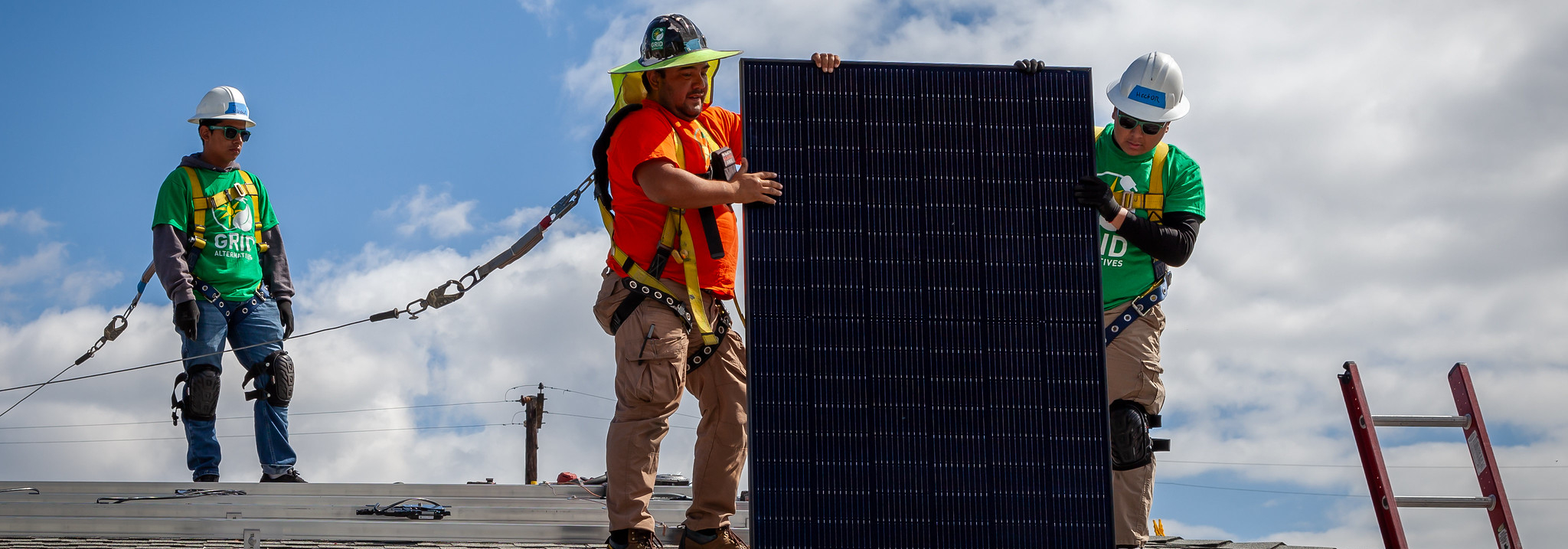
After moving through a series of roles at GRID, Prats is now a Solar Installation Supervisor. In this role, he trains new employees, teaching them to install the solar panel base, connect the panels, and wire everything to a home’s electrical system. As a trainer, Prats sees firsthand how GRID’s program offers an accessible opportunity for career preparation and fellowship to people of all backgrounds and experience levels, and appreciates the unexpected camaraderie that comes from that. As Prats put it: “We do a lot of training — for people coming out of prison, from unemployment, and some who are just interested in solar … This is a good place to get to know them, to talk to them, and find the good in everyone.”
Eager to expand his skill set further, Prats participated in a one-week training with a different GRID regional team to learn how to install batteries alongside solar panel systems. He also plans to pursue additional electrical certification, which GRID will help provide as part of their yearly professional development budget for staff. This new certification will help Prats to advance at GRID, making him eligible for future promotions. Speaking about his position with GRID, Prats described his satisfaction and his appreciation for these opportunities, both for his own development and in terms of his ability to help others: “I like being here [at GRID]. The job stability is good, and I have a chance to help people here.”
NADIA SÁNCHEZ had spent six years working as a civil engineer when she realized that the career wasn’t the right fit for her. She decided to pivot and quickly found a chance to do so when she saw a flyer at the library about GRID’s paid internship program. Curious to explore new career pathways, Sánchez applied, interviewed, and was offered the position — days before lockdowns began at the start of the COVID-19 pandemic. With her internship scheduled to start at the end of March 2020, when the pandemic escalated, she thought it would be canceled. But GRID modified the job training program to be remote, and Sánchez started her internship in late April.
Sánchez’s internship was focused on outreach to homeowners who were potentially eligible for GRID’s TCC-funded, no-cost rooftop solar panels. She provided administrative support and learned to use technical tools, like Salesforce. “The internship was very hands-on, even though it was virtual,” she said, praising how her supervisor made virtual learning engaging.
Sánchez also helped translate outreach materials to Spanish, using her native language to convey GRID’s mission and program details clearly and accurately. This was critical because many community members did not initially believe that the solar panels were free. “People are very skeptical … they’re like, ‘That sounds too good to be true. What’s the catch?’” Sánchez said this skepticism was GRID’s biggest hurdle to signing residents up for free solar panels, noting that many households had been “burned” by programs that claimed to be free but led to financial disaster. GRID gained legitimacy by working with the City of Ontario. As the pandemic waned, increasing in-person engagement helped build trust, too. “It’s been helping a lot since things have been opening up … we were able to have tabling events and [people are] seeing us more out there in the community,” she said.
When her internship ended, Sánchez had the opportunity to stay at GRID through an 11-month paid fellowship through which she continued to develop her outreach skills. She gradually took on more responsibility in her new role and gained new knowledge, learning about how orientations for new clients work, how to review contracts with clients, and even the construction process itself. As her fellowship drew to a close, Sánchez received an offer for a full-time position with GRID as their outreach coordinator, which she began immediately after the fellowship ended.
At GRID, Sánchez has been able to use some of the problem-solving and critical-thinking skills she learned as an engineer, while also developing new people skills and confidence. From cold-calling potential clients to giving presentations, she has grown into a more comfortable communicator. “It’s definitely helped me grow out of my shell … Before, having to do a tabling event or cold calling would be my worst nightmare … [This experience] helped me learn how to do it … [I’ve gained] a lot of people skills.”
The [job training program] gave me a paycheck and allowed me to pay my credit card debt. And it led me to this job now. So, it helped a lot.
Her internship, fellowship, and now full-time job at GRID also helped Sánchez through the economic hardships of the pandemic. GRID provided health benefits to its interns, and of course, the paid positions provided financial stability during a highly uncertain time. “I’m one of the lucky ones that found a job during the pandemic … Instead of being badly financially impacted, I came out a little bit better, because I found that internship,” she said.
Sánchez anticipates that the skills she has gained with GRID will be useful in ways she can’t yet predict. Through GRID’s job training program, Sánchez was able to discover a new career pathway, develop her professional skills, and gain financial freedom and job stability longer term.
Top page photo:
Francisco Javier Prats (center) teaches high school students to install a solar panel in March 2024. Photo credit: GRID Alternatives