
TCC builds capacity of local health activists to take on climate change activists to take on climate change
BACKGROUND
This case study examines how TCC activities are improving community members’ awareness of climate issues and related resources through their participation in the Community Health Improvement Association (CHIA) — the City of Ontario’s resident-led advisory board that constitutes a critical component of Ontario Together’s Community Engagement Plan (CEP). The case study spotlights the stories of two CHIA members, Tavis Díaz and María Quiroz, and the development of their leadership skills. See page 50 of this report for more information on Ontario’s CEP.
Interviews for this case study were conducted in December 2022 and January 2023.
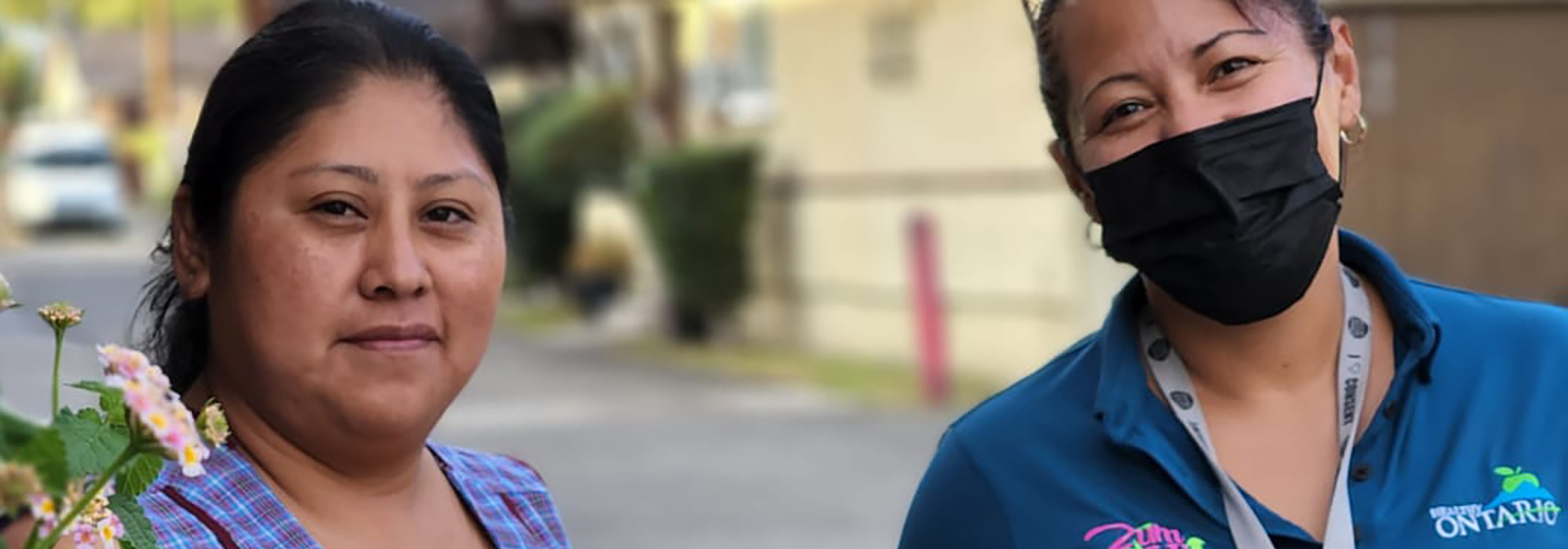
TAVIS DÍAZ has been a resident of Ontario for 23 years. She first became involved with Ontario Together by attending community Zūm Up! classes and later auditioning to be an instructor as part of the city’s Healthy Ontario Initiative (HOI). While serving as an instructor, she began to hear from fellow community members who sought information on local resources. Díaz began attending CHIA meetings and getting involved with local efforts motivated by a desire to serve as a resource for others.
CHIA — a resident-led advisory body that helps the city identify health and safety improvements needed in the community — emerged out of the HOI (see page 75 of this report for more on HOI). In 2017, CHIA worked with the city and HOI partners to identify local investment priorities for the city’s TCC proposal, also known as Ontario Together. CHIA has continued to play a key role in the Ontario Together CEP. Specifically, the CEP leverages CHIA’s monthly meetings with community members to crowdsource their expertise on how best to carry out TCC implementation activities.
In recognition of Díaz’s strong rapport with fellow residents, she was offered the opportunity to work as a paid resident leader with CHIA — a role that she describes as her most rewarding and which she continues today (see page 45 of this report for more information on the resident leader model).
Díaz credits her experiences with CHIA for providing her with a greater awareness of resources for mitigating and adapting to climate change. As a resident leader, she conducted outreach in her community to promote GRID Alternatives’ single-family solar panel installations. Despite the challenges in overcoming preexisting skepticism about “free” solar panels among residents, Díaz was able to successfully connect a fellow Zūm Up! attendee, Antonia Rojas, with the program. The opportunity to unite qualifying individuals with these free resources proved deeply satisfying, and for Díaz, proved to be one of her most gratifying experiences. Working with CHIA on community engagement efforts has also strengthened Díaz’s awareness of the barriers that residents face in getting the help they need—including a general sense of mistrust and fear. By understanding such challenges, Díaz now feels better equipped to overcome them in her continued work.
In addition to honing her community outreach skills, Díaz notes a significant change in her confidence and communication abilities. These skills have enabled her to take on more leadership responsibilities; most recently, by coordinating a CHIA meeting on her own.

Sometimes people are hesitant to ask for help. I have learned that you must go to the community and not expect the community to come to you.
I have many goals, and I believe the job I have with the city will help because … it opens new doors to new opportunities.
For Díaz, working with CHIA and Ontario Together has been deeply satisfying, and has allowed her to feel a part of the progress happening across the city. She hopes to continue leveraging her skills and knowledge of available resources, including those funded by TCC, to help her fellow residents address their needs. Notably, Díaz’s experiences have equipped her to become a leader especially in addressing issues relating to environmental and public health. She hopes to build on her skills and connections to open a small business with her son selling vintage fashions in Downtown Ontario that would leverage the city’s ample resources and provide new jobs in the community.
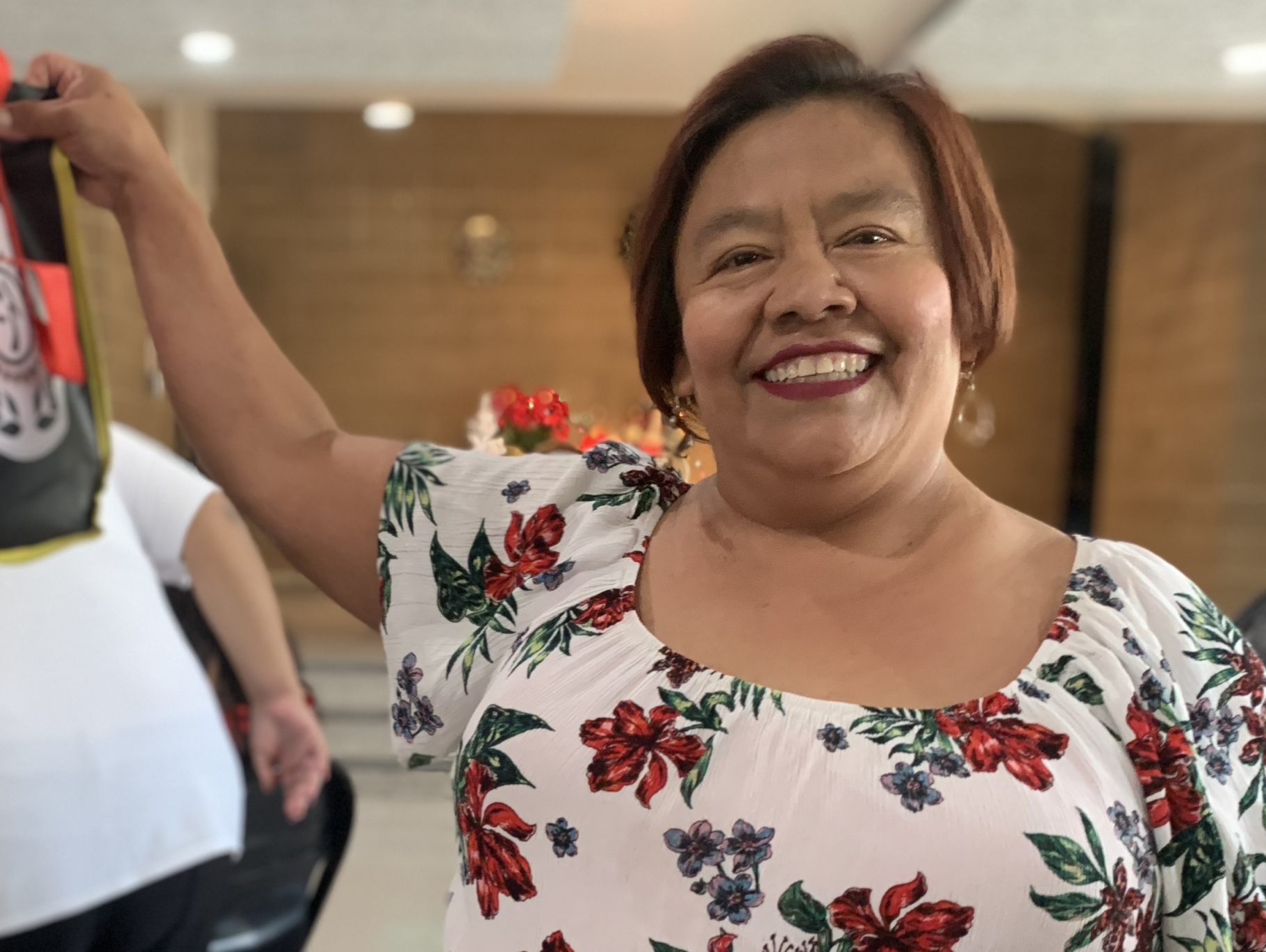
MARÍA QUIROZ moved to Ontario nearly three decades ago in search of a calm environment in which to raise her children. Motivated by a concern for her health, she began participating in local Zūm Up! exercise classes, which is where she first learned about CHIA. Quiroz ultimately joined CHIA as a community member, attending meetings and participating in local events.
For Quiroz, CHIA meetings have provided a platform to gain awareness of the city’s numerous health programs and resources, including but not limited to those funded by TCC, which have proved critical to improving her own health and enabling her to feel more involved in her community. CHIA meetings have also served as an opportunity for residents like Quiroz to learn about environmental and urban planning issues connected to TCC — such as air pollution, land use, and goods movement — and how these issues ultimately affect people’s health and well-being.
By participating in CHIA meetings, Quiroz has also gained awareness of climate-related resources, such as GRID Alternatives’ TCC-funded, single-family solar panel installations (see page 67 of this report for more information). This knowledge has helped her dispel misconceptions about the accessibility of those resources within her broader community.
The connection [between CHIA and TCC] is around health because everything about the environment ties back to your health.
You think [solar panels] are too expensive or you won’t qualify for them, but you don’t realize that … [the cost is dependent on] whatever you qualify for.
Beyond providing a space to share information, CHIA meetings have served as a platform for residents to voice their concerns and express their needs — an experience that personally inspired Quiroz to organize her fellow residents in collective action to gather signatures after their local Zūm Up! classes were unexpectedly decreased.
Ultimately, Quiroz’s experiences as a CHIA member and her exposure to TCC have positioned her to be a future leader in the climate action space. She not only has a greater understanding of the interactions between the built environment and public health, but she also has better awareness of available resources to address the negative impacts from those interactions. Additionally, CHIA has provided Quiroz an opportunity to strengthen her confidence in taking on societal challenges and in leveraging her knowledge to support her community. Developing this awareness and confidence constitutes an important f irst step in empowering individuals to take meaningful action in their community on a variety of important issues, like climate change.
Top page photo:
Resident leader Tavis Díaz (right) engaging with a community member. Photo credit: The Social Impact Artists