
Trucking program provides training ground for Fresnans to launch careers as commercial drivers
BACKGROUND
This case study illustrates how TCC funding for the West Fresno Advanced Transportation Technology (WFATT) job training program has helped Fresno residents break into the trucking sector and increase their earning potential. It highlights how the training provided John Roberts and Breanna Rogers with a supportive, flexible environment to master the skills needed for commercial trucking and quickly land higher-paying jobs in the sector.
For more on Transform Fresno’s Workforce Development Plan, see page 58. Interviews for this story were held in September and October 2023.
JOHN ROBERTS grew up in Fresno where he still lives with his wife, two kids, and grandson. Before the trucking driving program, he performed a number of tasks for work, such as stocking materials in a hospital, maintaining air conditioning units, manufacturing textiles, and removing products off trucks at Amazon. His most recent position at Amazon was particularly grueling. He often worked in the morning and then would work 10-hour graveyard shifts soon after.
In the back of his mind, Roberts had always been interested in truck driving as an alternative career because he knew that it had potential for growth and higher wages. However, he had not pursued it earlier because of the high costs of truck driving programs. That changed when he met Oscar Robinson, the project lead for WFATT, through his personal network. Robinson shared with him that he could get certified to be a truck driver at no cost. Sold on the free program, Roberts enrolled in the WFATT program in May 2022. “At $3,000, prices were astronomical for truck driving school. With WFATT, you don’t have to pay anything and would be able to get into a different field with better pay and more independence on the job.”
The WFATT program provides a combination of classroom and field-based experiential job training on the operation and maintenance of commercial trucks. The program can be completed in as quickly as four weeks full-time, but the program allows for flexibility, such that Roberts was able to complete the program over the course of a year, enabling him to factor in his challenging work schedule at Amazon.
In addition to training, WFATT provides career services such as case management, job readiness workshops, interview practice, and job placement. One of the goals of this program is also to expose trainees to low or zero-emission trucks. In fact, TCC provided funding for the program to purchase a demonstration truck powered by compressed natural gas.
Roberts completed the truck-driving program within a year. He credited the program with teaching him the ins and outs of driving and parking large vehicles, as well as how to prepare for the required tests with the DMV. Roberts felt that the training was beneficial because the instructors emphasized that he could take as long as he needed to feel comfortable behind the wheel and fully understand the driving mechanism. He was also encouraged to take the driving test as many times as needed.
Roberts was employed immediately after graduating from the driving program at a small trucking company that delivered produce cross-country. While the position came with more pay than his position at Amazon, it wasn’t a clear win in terms of job quality because the company would often not provide Roberts with enough money for fuel, leaving him stranded until his employer sent additional funds to refill his vehicle.
In search of better working conditions, Roberts left his first post-training position after 6 months for a position at a larger company. While the work is similar (Roberts still hauls produce across the country), the company is a much larger operation and has more resources for drivers, thus resolving the refueling dilemma in his last position. Robert’s income is about 30% more than before the program, which has allowed him to move into a larger home with more space and f lexibility for his family.

If you don’t pass and need to start the process again, the instructors are going to be there with you until you pass and complete the program.
After obtaining skills and experience at my current employment, in the future, I am optimistic I will have my own trucking LLC and my very own truck.
Roberts enjoys what he does, and relishes in getting to be his own boss, but believes there is room for improvement. While he is making more money than before the training, he still does not have benefits, such as healthcare or retirement. However, he plans to leverage his newfound trucking experience to move to an even larger company like Walmart, which provides benefits and also has a better pay scale than his current role. Further down the road, Roberts aspires to save enough capital to put towards his own trucking business.
BREANNA ROGERS was also raised in Fresno and now lives in her city of origin with her two toddler sons. For much of her life she struggled to figure out her true professional calling. At the age of 19, she worked in warehouses. Between the ages of 22 to 26, she worked in multiple service industry roles at restaurants and as a janitor.
While she was pregnant with her first son, she and her partner, a truck driver of 10 years, spent time on the road. This is how she first became exposed to a career in truck driving, but it wasn’t until she had her second child that she decided to seriously consider the career for herself.
Rogers eventually crossed paths with Oscar Robinson, the Project Lead at WFATT, who was performing outreach for the TCC-funded truck driving training program and encouraged her to apply. She started the program in May 2021 and received her trucking license in November of that year. With childcare support from her family, Rogers committed to the program full-time and was at school from 8 a.m. to 3 p.m. Through a program called Workforce she was also able to complete the program without incurring any tuition.
Rogers credits the WFATT training program with thoroughly exposing her to what she would be tested on at the DMV, and providing her the space and time to make mistakes and refine her trucking skills. For example, Rogers was especially challenged by truck parking maneuvers, such as parallel parking, which kept her from completing the certification the first two times she took the test. She leveraged the resources at WFATT, such as practicing with the truck that was purchased for the program, to sharpen these skills, and on her third try, she passed.
The program teaches you step by step the same steps that they will test you at the DMV.
The company I am at is a stepping stone to get better pay and benefits. I got into the trucking industry so I can retire early and kick my feet up.
After getting her commercial trucking license, Rogers shopped for jobs and was eventually hired at a long-haul company delivering produce and clothing, where she still works. Rogers quickly impressed her employer, and in less than a year, she was promoted to train new drivers. The new position comes with a 60% pay increase from when she was a janitor, as well as health and retirement benefits.
In the next five years, Rogers would like to pivot from working for a long-haul trucking company to one that operates regionally so she can spend fewer nights away from home and more time with her kids. She would also like to work for a company that offers health insurance that not only covers herself but also her children. In the longer term, she hopes to put away enough money in savings so that she can retire at the relatively young age of 50, thereby maximizing the time she has to spend on what matters to her most in life: her family.

Top page photo:
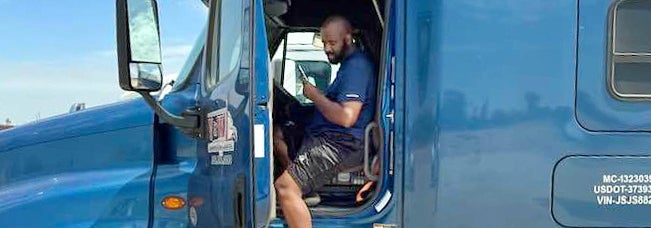
John Roberts in truck. Photo courtesy of John Roberts