
The distribution of urban forests in California reveals that under-resourced cities and neighborhoods tend to have fewer trees due to discriminatory urban planning and investment decisions. Planting trees provides many human health and environmental benefits, including protection from extreme heat – one of the deadliest impacts of climate change. However, increasing the tree canopy in Los Angeles is challenging because of its extensive roadways, semi-arid climate, and diversity in income.

We provide specific, practical solutions to improve health outcomes for community members, local groups, and municipal leaders.
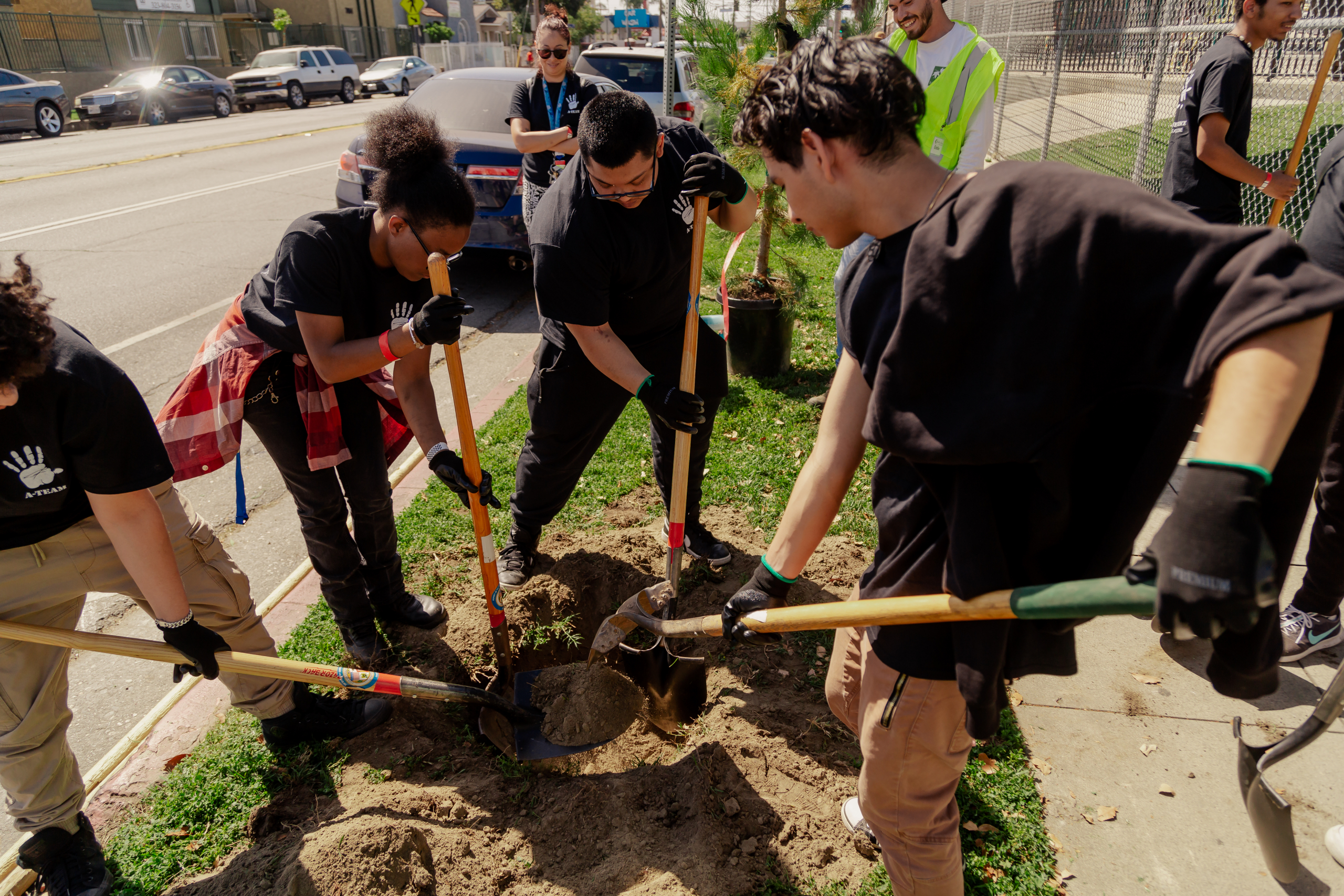
Credit: North East Trees

CURRENT PROJECT(S)

The Luskin Center for Innovation has partnered with the City of Los Angeles Office of Forest Management, which regularly seeks our advice on best practices for urban forest equity planning. The decision-making framework we pioneered with the LA Urban Forest Equity Collective has been adopted by the city in its urban forest management planning process.

Researcher(s): Edith de Guzman, Rachel Malarich, and Clarissa Boyajian

The Luskin Center for Innovation co-leads the Urban Forest Equity Collective, a consortium of forestry experts, LA city staff, community-based organizations, researchers, and consultants. The Collective aims to create holistic strategies to advance urban forest equity in the lowest-canopied neighborhoods in LA. By conducting a comprehensive analysis and creating strategies, the group works to address decades of systemic disinvestment and planning decisions that have resulted in poor public health outcomes, limited access to green spaces, and a host of related consequences ranging from heat exposure and poor air quality to food insecurity and reduced ecosystem services.

Learn more

Researcher(s): Edith de Guzman, UCLA; Rachel O’Leary, California Department of Forestry and Fire Protection; Rachel Malarich, City of LA; Marianna Babboni, USC Public Exchange; Monica Dean, USC Public Exchange

Luskin Center for Innovation staff is advising on the National Science Foundation-funded heat and urban forest science Empowering Changemakers: Urban-Biodiversity Initiative for Teachers and Youth (ECUITY). The initiative is developing an environmental justice biodiversity curriculum for middle schools in Los Angeles, supporting the City of Los Angeles’s goal of zero net biodiversity loss.

Researcher(s): Edith de Guzman, Travis Longcore, Mas Dojiri, and Jill Grace
Funder: National Science Foundation

PUBLISHED RESEARCH

Researcher(s): Edith de Guzman, Francisco J. Escobedo, and Rachel O’Leary

By adapting a framework regularly used in the public health field to evaluate urban forest equity and well-being, the researchers developed a model of community-based tree stewardship to reveal how interacting dimensions — from individual to society level — drive urban forest equity and related public health outcomes. The research can inform urban forestry policy, planning, and management actions to support increasing tree cover and reducing heat exposure in marginalized communities.

Read the article