
Safer streets, stronger community: How sidewalks transformed daily life in Pacoima
BACKGROUND
This case study focuses on how TCC-funded street improvements have helped residents in their day-to-day lives. From children walking to and from school, to elderly residents with physical disabilities being able to move around safely, and others who enjoy walking around their neighborhood. Alma Palomares and Becky Dominguez are two Pacoima residents who have specifically benefited from street improvements on their block. To learn more about TCC, visit our TCC page.
ALMA PALOMARES came to live with her mother and siblings in the Pacoima community about 45 years ago. Palomares and her husband achieved a life goal of purchasing a house and raising their children in Pacoima. Multigenerational living is very common there, and over the years, they added an extension to the home to accommodate her daughter’s family.
As a stay-at-home parent and part-time house cleaner, Palomares enjoyed the flexibility to work around her childrens’ schedules. When they were young, she often would walk them to school, but she did not feel safe because there were no paved sidewalks. Nevertheless, she did not have a choice. About a year ago, she learned that her street would finally be getting 2.4 miles of street improvements, including 900 feet of new sidewalks, 5 way-finding signs, 10 ADA ramps, and 3 high-visibility crosswalks. Palomares was ecstatic about this.
The improvements are especially important to Palomares because she has fallen outside her house due to the uneven dirt and rocky road. She became fearful of leaving her house, and with her walker, she has struggled to find space to move around. Previously, she struggled to get into vehicles due to the uneven ground around her home, but now the curb cuts make it easier. Another issue with the dirt sidewalk was the dirt that entered her home. This would aggravate Palomares’ asthma and respiratory allergies.
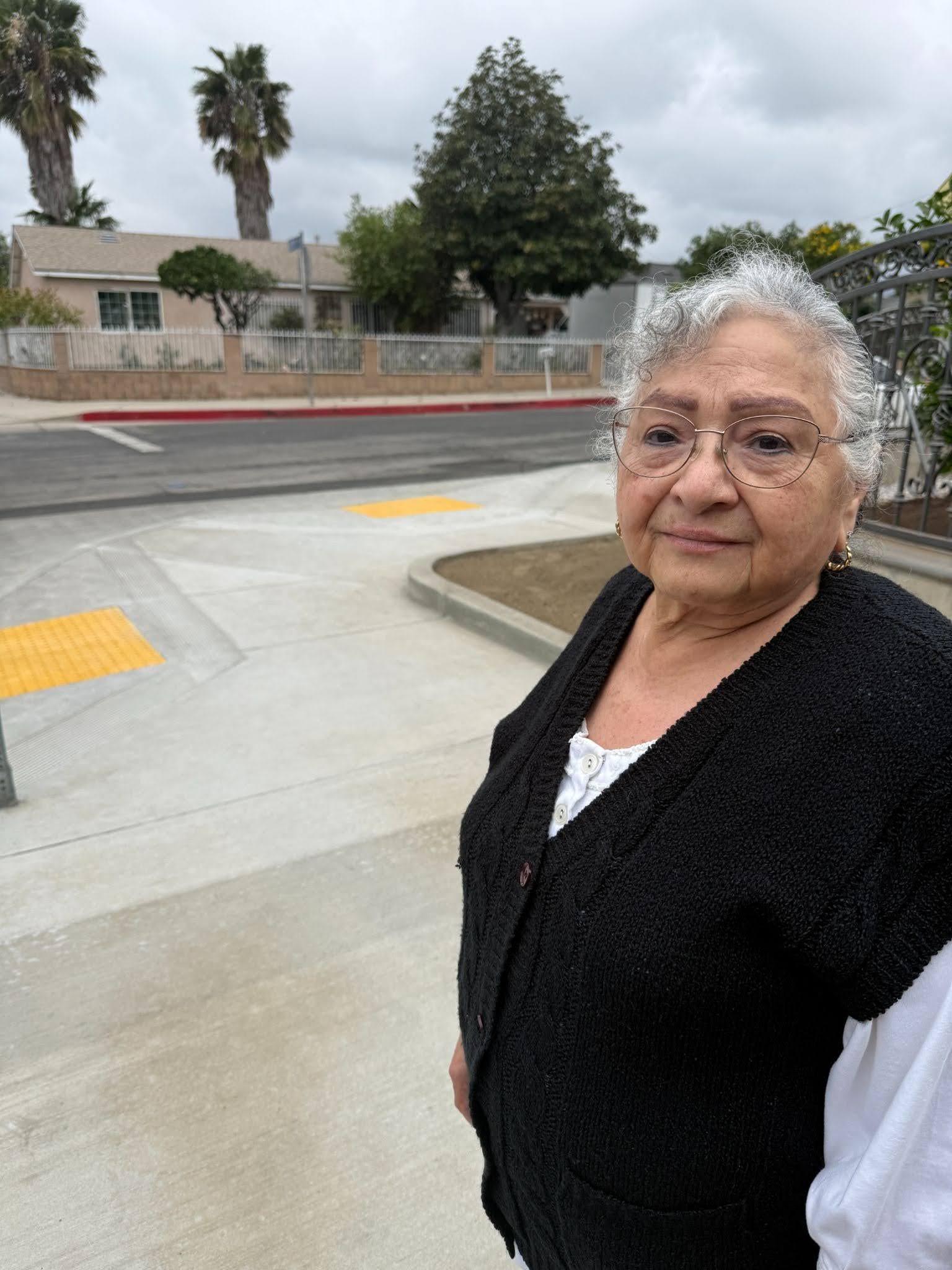

My dreams came true … we are happy that the street improvements were realized in my lifetime. All the neighbors who know me were happy that I was finally able to feel comfortable leaving my front door because I finally had a proper sidewalk. Many neighbors have complimented my house, stating that it looks like a brand new home with a new sidewalk, trees, and fence.
After the sidewalk was installed and new trees were planted, Palomares’ well-being has noticeably improved. She feels safe to leave her home with her walker, enter vehicles from the sidewalk, and her mental health has improved as well. Palomares says she feels at peace and calmer knowing that she can safely move around her neighborhood. She is even making trips to visit her neighbors, which she couldn’t do before due to her limited mobility. In addition to these benefits and her street’s beautification, her daughter paid for a new fence around the property to inaugurate the new street updates. Palomares states that she feels like she has a brand new house.
BECKY DOMINGUEZ has lived in Pacoima for over 60 years. She has one son and three grandchildren who all live in the community. Her favorite part of her neighborhood is the tight-knit community filled with people who hold similar family values. Everyone helps and takes care of each other.
For years, Dominguez and her neighbors wished their street had paved sidewalks and speed bumps to limit vehicles from driving fast. They asked city officials for these safety features, but they were told it was not possible. It wasn’t until the Green Together Collaborative knocked on their doors, informing residents that their streets would finally get a sidewalk.
Dominguez was especially pleased because she often walks her grandchildren on a dangerous dirt road to and from the local school. Many of her neighbors drive their children to school to avoid the dirt roads, even though they prefer walking.
Once construction began in December 2025, the neighbors did not mind the noise or inconvenience it would cause because they waited for paved sidewalks for years. In addition, new crosswalks and improved signals force cars to slow down. The trees on her street, which were overgrown, were also trimmed, helping make the signage visible for drivers and pedestrians. Now, with the new street improvements, Dominguez sees children walking to and from the local school. She even feels comfortable letting her grandchildren walk by themselves, something that was a constant worry before.
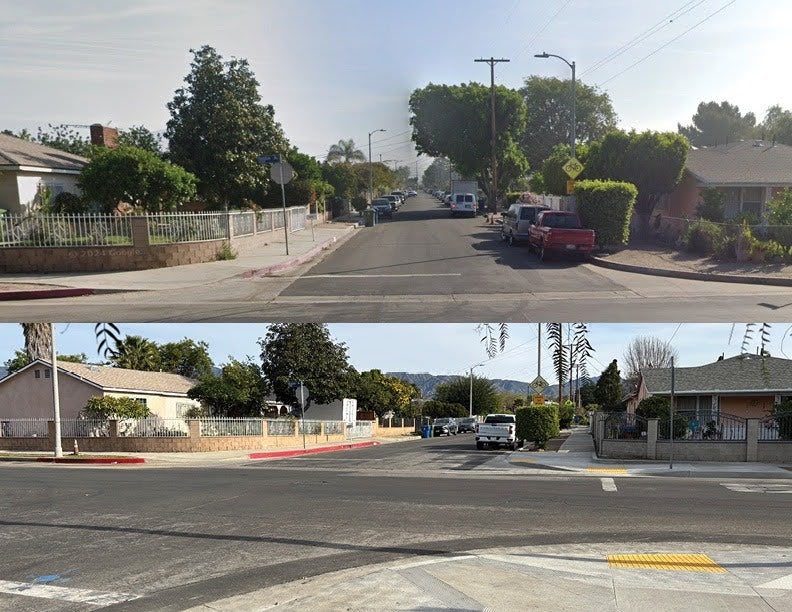
Now [the street] looks beautiful. It makes you feel good walking down … to the little market where you can eat food and everything. You don’t have to drive anymore. So you save gas.
Dominguez has noticed that her elderly neighbors are taking advantage of the street improvements as well. She said they feel safe and comfortable walking with paved sidewalks, and the curb cuts help those who need wheelchair accessibility. Dominguez is happy that all neighbors of all age ranges are enjoying the improvements, and everyone is helping keep the streets clean by sweeping and cleaning up trash — in true Pacoima fashion.
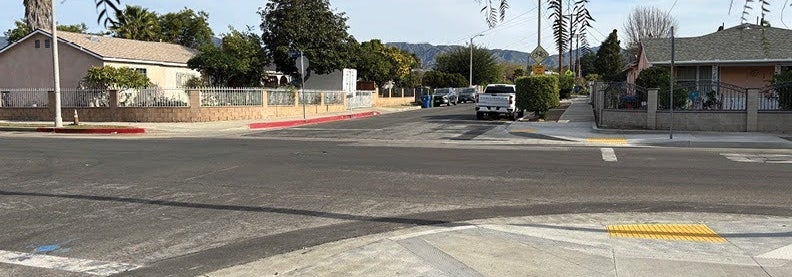
Top page photo:
Haddon Avenue and Weidner Street in January 2026 after a sidewalk pavement, cut curbs, and improved signage were installed
Photo credit: UCLA Luskin Center for Innovation