
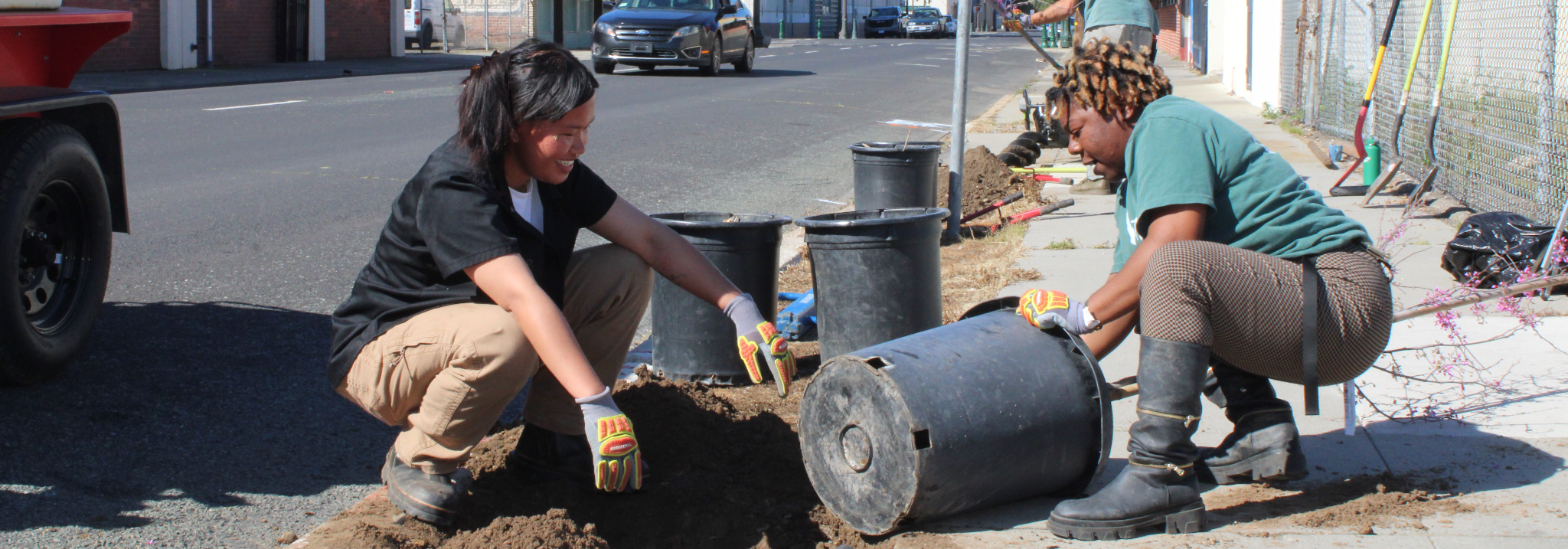
Green Paths program trains next generation of urban foresters
BACKGROUND
This case study documents how TCC funding for job training has prepared Stockton residents for the professional demands of planting trees in urban settings. Specifically, this story highlights the journeys of Glenabel Toreno and Venicia Johnson, who both completed the Green Paths training program led by Little Manila Rising. For more on this program, as well as Stockton Rising’s broader Workforce Development and Economic Opportunities Plan, click here.
Interviews for this story were conducted in October and December of 2025, respectively.
GLENABEL TORENO moved to Stockton from the Philippines with her parents when she was eight years old. She comes from a family with a long history in agriculture, which is the trade that ultimately brought her parents to Stockton. She’s the oldest of four children who have all made a home for themselves around the Central Valley.
After graduating from high school, Toreno began chartering her own course in the agricultural sector. Growing up on the southside of Stockton, she was acutely aware of the challenge of living in a food desert, and as a result, was interested in devoting herself to food justice. She explored that interest by doing a fellowship through AmericCorps with the Edible Schoolyard project in Stockton, followed by a stint with the Black Urban Farmers Association.
Toreno’s interest in environmental justice eventually expanded beyond food access to include tree access. So when she saw Little Manila Rising post on social media about a training opportunity through its Green Paths program, Toreno decided to apply and broaden her work experience.
In the program, Toreno learned about soil science, tree biology, and careers in urban forestry. She also gained public speaking skills, which she put into practice when engaging community members about Little Manila Rising’s free tree program.

I had past experience before in agriculture, but I really didn’t know much about trees and even, like, career paths I can do that’s tailored towards taking care of trees. So that’s something that I’m very grateful for, just this introduction [to urban forestry].
Towards the end of her training, Toreno learned of a full-time forestry technician position at Little Manila Rising. With the help of her training supervisor, she revised her resume and crafted a cover letter for the position, which she was eventually offered.
In this role, Toreno is expanding her technical and communication skills. On the technical side, she has learned how to drive a work vehicle with a water trailer attached to it. And on the communications side, she’s become more comfortable being on a public stage. Notably, she spoke on a panel organized Trust for Public Land about creating and maintaining healthy spaces. Off stage, Toreno has sharpened her interpersonal skills by navigating challenging conversations with community members who have had negative experiences living near or caring for trees.
I used to be so timid and so scared to be approached by community members when they have questions, just because I didn’t want to say, like, the wrong answers to them and give them wrong information. But throughout this job, it really taught me that those are your neighbors, you’re just talking to your neighbor.
Even though I may not reap the benefits of a mature tree, I know that generations after me will. So it’s very inspiring and fulfilling work.
Coupled with more training, Toreno hopes to continue working in urban forestry for the foreseeable future. One near term goal of hers is to get certified as an arborist through the International Society of Aboriculture. This work is more than just a professional pursuit for Toreno, it’s also a source of personal meaning.
VENICIA JOHNSON, originally from Oakland, moved to Stockton in search of housing affordability when she was 25 years old with her daughter. Johnson’s other family members are spread out around the San Francisco Bay Area, so the transit connectivity of Stockton was particularly appealing to her.
When she got to Stockton, Johnson was in search of recreational opportunities for her and her daughter. She eventually came across Little Manila Rising’s free karate classes and soon learned of the organization’s Green Paths program.
As a former graduate of Civicorps, a youth job training program in Oakland, Johnson had already got her feet wet working in the landscaping sector and was eager to continue that work. Like Toreno, Johnson is passionate about addressing the harms of environmental racism and improving access to healthy food and public green space. Thus, Johnson saw the Green Paths program as a good opportunity to build on her previous work experience and personal interests, and to do so in her new community.
Once enrolled in the program, she learned not only the basics of proper tree planting, but also broader land management practices. Johnson was particularly inspired by a documentary that was screened during the program about indigenous practices in which controlled burns were used to prepare arable land for crop production.
The best thing that I learned from Green Paths was the [role of] good fire. I knew nothing about good fire [before the program]… [So] that was a beautiful thing to learn.
As with Toreno, the Green Paths program provided Johnson a deep dive into the social dimensions of tree planting, especially the outreach needed to build trust with residents who are skeptical of neighborhood change, no matter how well intentioned. This was one of the more salient learning outcomes for Johnson. Before the training, Johnson hadn’t fully appreciated all the language and cultural barriers that exist between residents within Stockton, which can get in the way of trust building.
After completing the Green Paths program, Johnson was eager to keep exploring career opportunities in different professional trades which are needed to address climate change. For example, she completed GRID Alternative’s TCC-funded solar installation job training program and recently began a training program with EVGo, which builds electric vehicle charging infrastructure. The exploratory nature of these training programs is ideal for Johnson because she wants to be sure she loves what she does for work before she commits to it for the long-term.
It really changed my outlook on community outreach and how people could speak to one another … we can’t just only talk to ‘our kind’ and people that look like us.
I can turn all of my training into employment, but most importantly, I need to know and love what I’m doing. So far, I pretty much loved all of the trainings, and I do want to use them in my own life at a later date for sure, I’m not just learning to just learn it.
Regardless of her path, Johnson is confident she will make use of everything she’s learned, if not professionally, then personally. One day she would like to own property, which she’ll be well suited to maintain and upgrade now that she has some landscaping, forestry, construction, and electrical skills under her belt.
Top page photo:
Glenabel Toreno and Venecia Johnson prepare a tree for planting along a sidewalk in the Stockton Rising project area
Credit: Little Manila Rising