• Letter from the Director
  • Strategic Roadmap
  • 2025 Impact Report
  • Contact
    Us
  • Give
    Now
UCLA Luskin Center for Innovation
  • About
    • Mission, Approach, & Values
    • Policy Impacts & History
    • Team
    • Advisory Board
    • Collaborators
    • Student Opportunities
  • Research
    • Current Projects
    • Climate
    • Energy
    • Fire Hub
    • Heat
    • Transportation
    • Urban Greening
    • Water
    • All Publications
  • News
  • Events
    • Calendar
    • Webinar Library
  • Support
    • Giving Opportunities
    • Support Students
  • Subscribe
  • Media
    • Contact Our Experts
    • Select Media Coverage
  • Click to open the search input field Click to open the search input field Search
  • Menu Menu
  • The Problem with Hot Schools

    Infographics on Heat-Resilient Schools

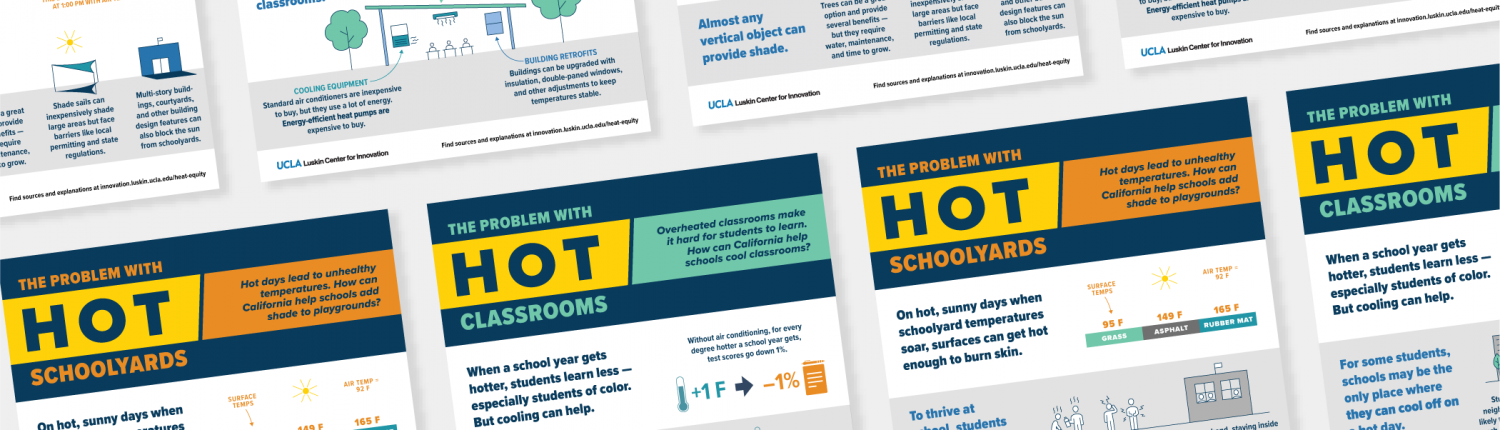
Extreme heat is a growing problem for California’s schools. Lack of air conditioning leaves classrooms too hot to maximize learning, while lack of shade puts students at risk in schoolyards. The problems and solutions are more complex than one might think — tradeoffs abound, and the tension between state and local responsibility and control is palpable.

To present a simple starting point for understanding how heat affects students, we’ve put together a set of fact sheets and infographics that boil down lots of complexity into a few brief pages. Below, our infographics layout The Problem with Hot Schoolyards and The Problem with Hot Classrooms, with a few paragraphs on each to provide context and citations.

The Problem with Hot Schoolyards
test

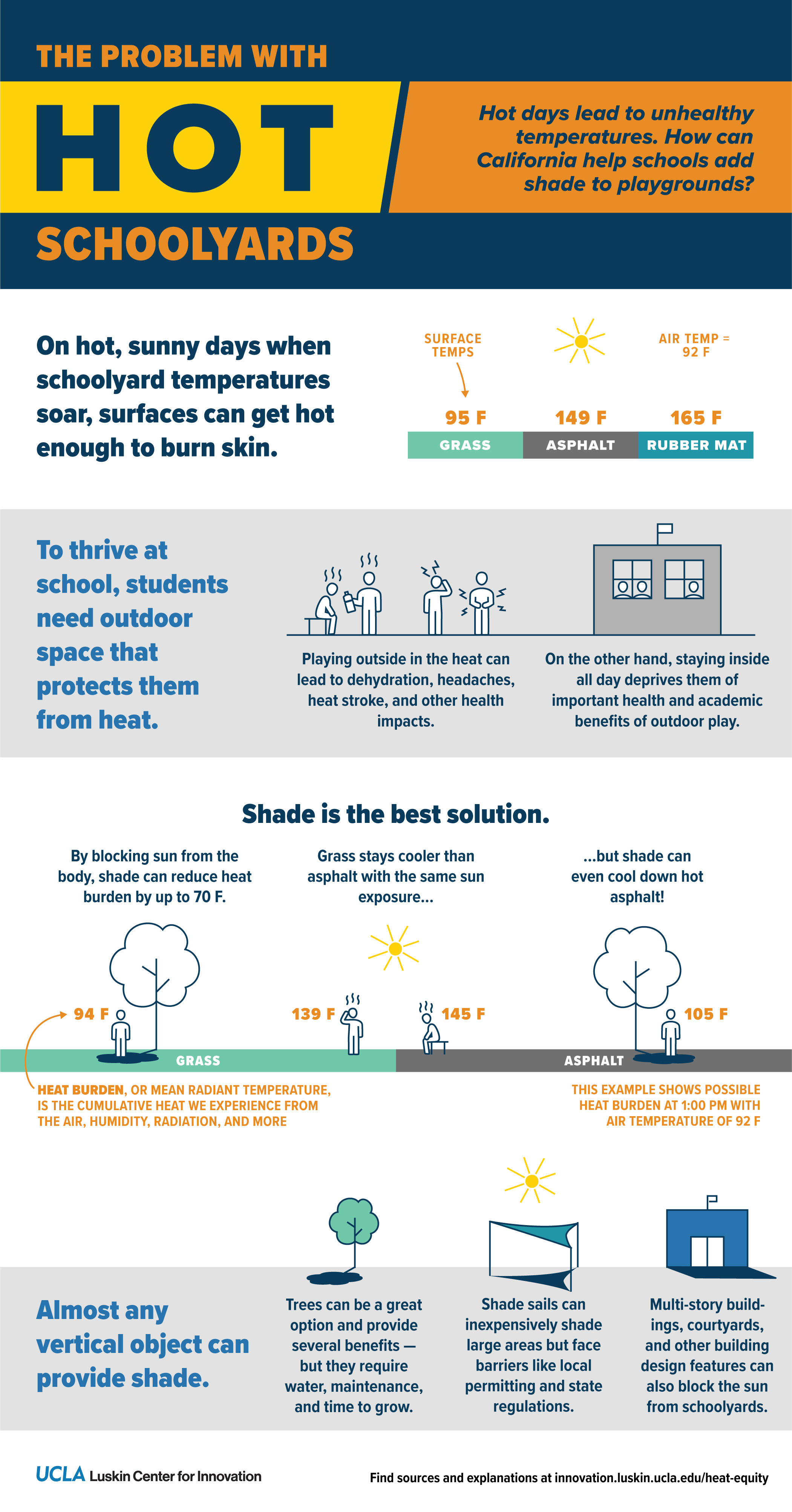
This infographic lays out some basics to illustrate why overheated outdoor play areas are a problem for students. Here are some contextualizing details and citations:

  • Surface temperature: The surface temperatures listed in the graphic are actual temperatures measured at or near an elementary school in Pacoima, a neighborhood in Los Angeles. The measurements were taken when the air temperature was 91 to 92 degrees Fahrenheit. Source: Turner et al. 2023. “Site Design and Human Heat Burden in Pacoima, California.”
  • Heat burden: Heat burden is a colloquial term for mean radiant temperature, or MRT, which measures the net heat exposure from multiple sources: air, humidity, wind, incoming short and longwave radiation, radiant heat from surface, etcetera. The numbers for heat burden in this graphic come from a model that estimates MRT for different shade and surface scenarios at 1:00 pm at that same school in Pacoima. Source: Turner et al. 2023. “Site Design and Human Heat Burden in Pacoima, California.”

To learn more, read our fact sheet, “Protecting Students from Heat Outdoors,” or our policy brief, “Protecting Californians with Heat-Resilient Schools,” both of which are accessible here.

The Problem with Hot Classrooms
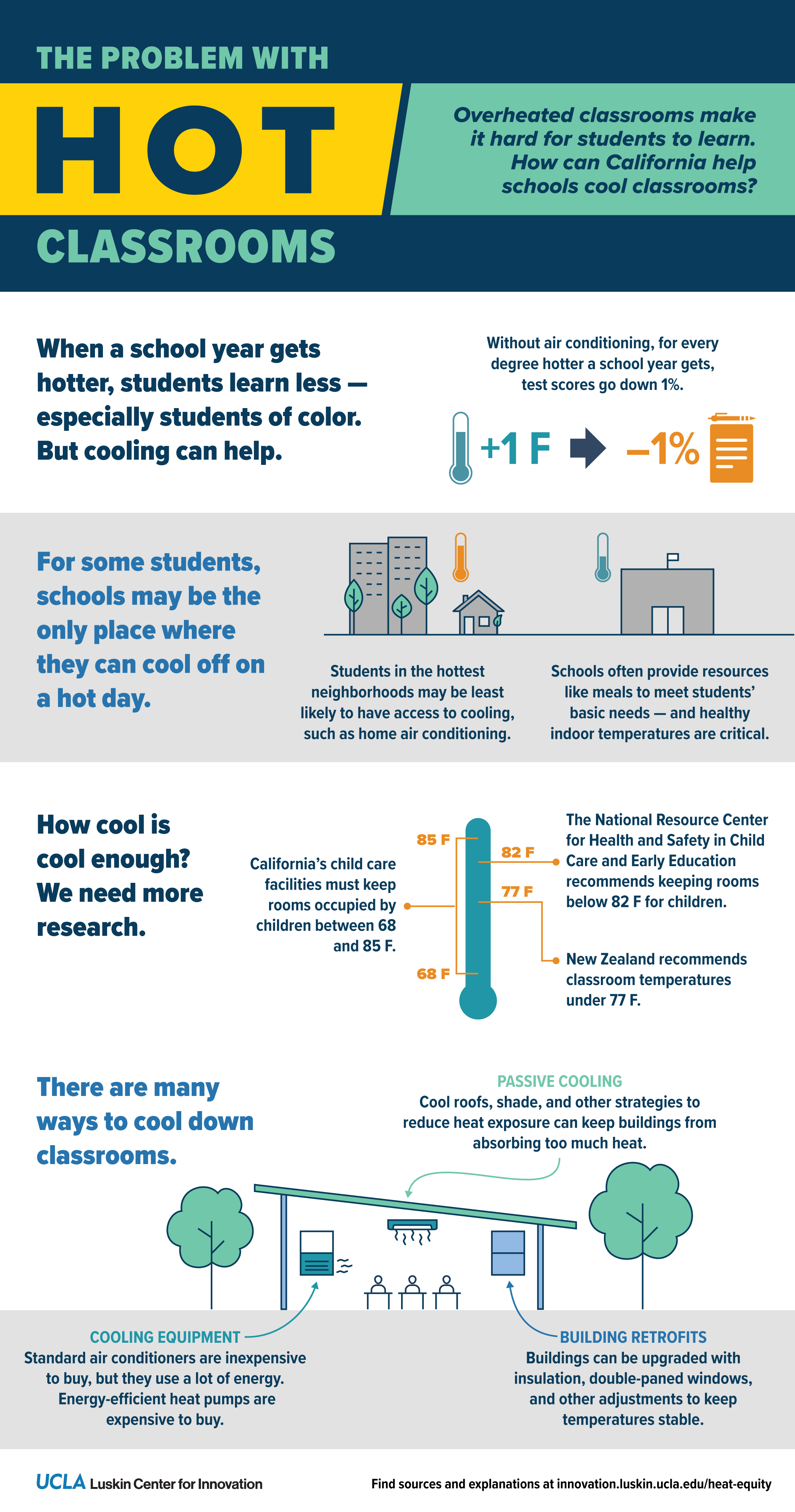
This infographic lays out some basics to illustrate why overheated classrooms are a problem for students. Here are some contextualizing details and citations:

  • Test scores: Park and colleagues (2020) showed that without cooling equipment in classrooms, an increase in average school year temperature of 1 degree Fahrenheit leads to 1% less learning for that year, as measured by changes in test scores. Source: Park, R. Jisung, Joshua Goodman, Michael Hurwitz, and Jonathan Smith. 2020. “Heat and Learning.” American Economic Journal: Economic Policy, 12 (2): 306-39.

To learn more, read our fact sheet, “Cooling Classrooms to Healthy Temperatures,” or our policy brief, “Protecting Californians with Heat-Resilient Schools,” both of which are accessible here.

Authors

  • V. Kelly Turner, associate director
  • Ruth Engel, project manager for environmental data science
  • Lauren Dunlap, project manager for energy research

Funding Acknowledgements

Funding for this project was provided by the Resources Legacy Fund.

More Recent Climate Research

UCLA partners with new independent Blue Ribbon Commission for climate-resilient L.A. fire recovery

February 14, 2025
UCLA scholars will provide research-informed options to inform policy recommendations to rebuild, retrofit, and catalyze climate-resiliency investments.
https://innovation.luskin.ucla.edu/wp-content/uploads/2025/02/0214-News-Story-Featured-Image-e1739567050659.jpg 843 1600 angela wu https://innovation.luskin.ucla.edu/wp-content/uploads/2024/07/web-headers-2024-07.png angela wu2025-02-14 13:26:012026-01-23 12:28:36UCLA partners with new independent Blue Ribbon Commission for climate-resilient L.A. fire recovery

For the Press: UCLA research and commentary on the L.A. fire response and recovery

January 16, 2025
Our experts are available to comment on: 1) water supply and urban water systems; 2) air quality and public health impacts; 3) land use and governance considerations; 4) politics of disaster and response; and 5) climate whiplash and extreme weather.
https://innovation.luskin.ucla.edu/wp-content/uploads/2025/01/palisades-fire-e1737060005878.jpg 1250 2500 Mara Burstein https://innovation.luskin.ucla.edu/wp-content/uploads/2024/07/web-headers-2024-07.png Mara Burstein2025-01-16 12:20:392026-03-25 21:20:24For the Press: UCLA research and commentary on the L.A. fire response and recovery

On the fires, from UCLA Luskin Center for Innovation

January 14, 2025
In the coming weeks, we will work with our colleagues at UCLA and partners across the region to help shape efforts that expedite recovery while advancing equity and resilience in our rapidly changing environment.
https://innovation.luskin.ucla.edu/wp-content/uploads/2024/07/LCIO-Featured-Image-Logo-1.png 640 1210 angela wu https://innovation.luskin.ucla.edu/wp-content/uploads/2024/07/web-headers-2024-07.png angela wu2025-01-14 10:38:262025-03-20 10:32:52On the fires, from UCLA Luskin Center for Innovation
Page 2 of 18‹1234›»

© Copyright – UCLA Luskin Center for Innovation – Enfold WordPress Theme by Kriesi
Terms of Use
The UCLA Luskin Center for Innovation acknowledges the Gabrielino/Tongva peoples as the traditional land caretakers of Tovaangar (the Los Angeles basin and So. Channel Islands). As a land grant institution, we pay our respects to the Honuukvetam (Ancestors), ‘Ahiihirom (Elders) and ‘eyoohiinkem (our relatives/relations) past, present and emerging.
Click on the linked words to hear the pronunciation for the Tongva-language words.
3323 Public Affairs Building, Box 951656, Los Angeles, CA 90095-1656
Phone: 310-267-5435 | Fax: 310-267-5443
Scroll to top Scroll to top Scroll to top