By Mara Elana Burstein and Alison Hewitt
As urgency grows to develop climate solutions, a new UCLA report confirms that the wastewater recycling plans for the nation’s second-largest city would make Los Angeles more resilient and self-reliant during droughts or disasters that cut off outside water supplies.
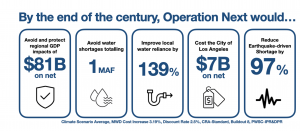
Using a new methodology to evaluate hundreds of thousands of scenarios, the UCLA research team, led by the Luskin Center for Innovation (LCI), found that the Los Angeles city plan would significantly boost local water resilience, minimize risks of aging infrastructure and uncertain water imports, and dramatically reduce drought- and earthquake-driven water shortages. Other cities dependent on imported water, such as Phoenix and Las Vegas, could use the new methodology to shape their own water solutions.
Los Angeles’ wastewater (used water) treatment plan, Pure Water Los Angeles, would create a renewable local water source of more than 250,000 acre-feet of clean drinking water, enough for more than half a million households annually. To support the city’s goal to recycle all wastewater by 2035, the Los Angeles Department of Water and Power committed to invest at least $6 billion in the infrastructure project, previously called Operation Next (OpNEXT). Supporting local water supply transitions is needed not just in Los Angeles, but also in other densely populated urban areas around the world.