September 10, 2026
Restoring public confidence in drinking water after wildfires
UCLA-led workshop with more than 50 experts identifies communications, research, and policy priorities

September 10, 2026
UCLA-led workshop with more than 50 experts identifies communications, research, and policy priorities
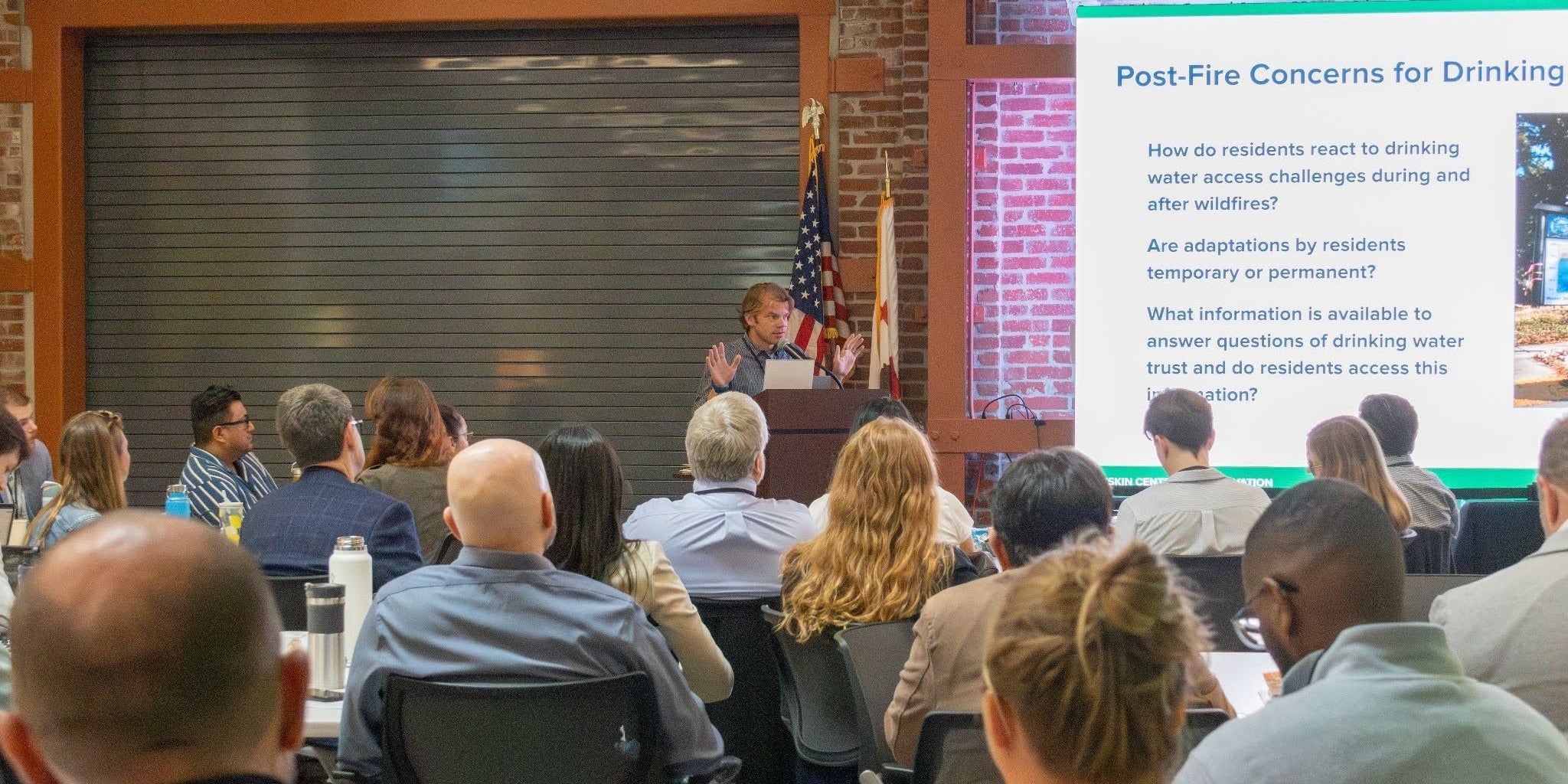
Photo credit: Selin Filiz, Sustainable LA Grand Challenge
Key Takeaways
After a wildfire, water systems face two challenges: physical damage to the system and public trust. Fires can damage pipes, treatment facilities, and storage, while contaminants may enter the water system and take time to detect and remove. At the same time, residents may be asked not to use their tap while systems are assessed and repaired. But even after service is restored, people may remain unsure whether their water is safe. Water systems need both the capacity to restore service quickly — and clear, trusted communications to tell residents when tap water is safe to use again.
Those findings are at the center of a new workshop synthesis report from the UCLA Luskin Center for Innovation and UC Agriculture and Natural Resources. The report draws on a May 2026 workshop with 54 participants from water utilities, regulatory agencies, research institutions, community organizations, journalism, consulting, and public health.
Participants emphasized that water systems, especially smaller ones, need greater capacity before an emergency occurs. That includes identifying laboratory contacts, establishing communications protocols and community partnerships, participating in mutual-aid networks, and planning for emergency operations in advance of a disaster. Participants also pointed to investments in backup power, rapid repairs, and state and regional coordination that can supplement local capacity.
After the 2025 L.A. fires, affected communities faced boil-water notices, do-not-drink advisories, and do-not-use orders as they tried to determine whether their tap water was safe. Post-wildfire communication presents a particular challenge: officials may first need to warn residents not to use their water, and then convince them it is safe again.

Recent wildfires have shown that recovering from a disaster isn’t just an engineering challenge. Communities also need to see, understand, and trust the messages that their water is safe again.
Restoring confidence requires establishing trusted communication channels before disasters occur. Residents often turn to many sources aside from their water utility for information — neighbors, community organizations, local journalists, and social media — making coordination with trusted local messengers essential during recovery.
“Partnering with local journalists to convey timely, accurate information is particularly important,” explained Edith B. de Guzman, cooperative extension specialist at the UCLA Luskin Center for Innovation. “They already have relationships with the community and can translate technical jargon into accessible, actionable information that residents can use.”
The workshop was the third in a four-part series organized through the Urban Water Supply + Fire Research and Policy Coordination Network, a collaboration led by the UCLA Luskin Center for Innovation and UC Agriculture and Natural Resources with support from the UCLA Sustainable LA Grand Challenge. Previous workshops examined water systems’ firefighting capacities and the financial challenges of wildfire preparedness and response. A fourth workshop in September will explore the nexus of water conservation, urban vegetation, and wildfire.
Learn more about our water systems and fire resilience research.
Get our latest research in your inbox.
 How data centers are uniting Americans from across the partisan divide
UCLA’s Megan Mullin on the economic and political calculations surrounding AI growth
 Water, fire, and finance: building more resilient systems
UCLA-led convening highlights need for clearer roles, stronger coordination, and more equitable financing strategies
 Blueprint for a better planet
How Luskin Center for Innovation and other parts of UCLA are advancing a healthier, more sustainable future.
 How data centers are uniting Americans from across the partisan divide