
Most cities and public spaces were not designed to mitigate heat. We are demonstrating how trees and other forms of shade affect people’s heat experiences and measuring the impact of shade in places such as homes, schools, and streetscapes.
We are expanding our support for local heat planning by leading a new federal Center for Excellence for Heat Resilient Communities. With a first-of-its-kind grant from the National Oceanic and Atmospheric Administration’s National Integrated Heat Health Information System and in collaboration with 50 partners, we aim to assist governments in safeguarding public health and well-being from heat. Our approach is data-informed to mitigate and manage heat in different communities and heat-exposure settings.
We are also working with local government agencies, including the City and County of Los Angeles, and their nonprofit and community partners to guide their adoption of evidence-based policy and program actions to protect the most heat-vulnerable communities.
To learn about our work on urban forestry, click here.
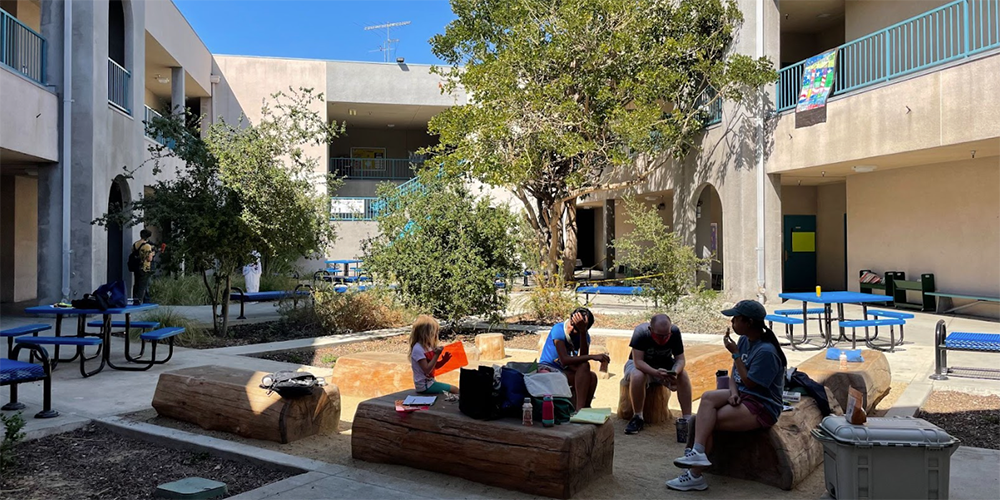
An example of courtyard shade and a nature-based outdoor learning environment at Esperanza Elementary School, Los Angeles. Photo credit: V. Kelly Turner / UCLA Luskin
PUBLISHED RESEARCH
Hot Observations About Shade in Omaha (2026 research brief)
Based on Data from our National Shade Map
Researcher(s): Jean Claude Iradukunda and V. Kelly Turner
The brief examines shade coverage across Omaha, finding that the city has about as much shade as the average American city but significant disparities between neighborhoods. It highlights the importance of trees for midday shade and calls for targeted investments in low-shade areas, particularly places where people are exposed to heat, such as schools and public transit.
Engaging the Public on Shade Equity Through Art (2026 report)
Roots of Cool: A Celebration of Trees and Shade in a Warming World
Researcher(s): Edith B. De Guzman, Scarlett Blythe, Stella Faulkner, Cate Gregory, and Leonard Holler
Funder: UC Agriculture and Natural Resources; Perenchio Foundation; Accelerate Resilience L.A., a sponsored project of Rockefeller Philanthropy Advisors; TreePeople; and Heather Sturt Haaga, and Paul G. Haaga, Jr.
This report examines Roots of Cool: A Celebration of Trees and Shade in a Warming World, an interactive art exhibition at Descanso Gardens that explored how arts-based engagement can build public understanding of shade equity while gathering community perspectives on climate adaptation. Analysis of more than 3,500 survey responses and nearly 2,000 visitor postcards found an overwhelmingly hopeful, solution-oriented outlook and demonstrates that interactive art exhibitions can serve as effective climate communication and participatory research tools.
Read the report | Read the news story
Hot Observations About Shade in Tulsa (2026 research brief)
Based on Data from our National Shade Map
Researcher(s): Jean Claude Iradukunda and V. Kelly Turner
This research brief summarizes our experts’ observations about Tulsa from our national Shade Map, created by the Luskin Center for Innovation and American Forests. The researchers find that 1) Tulsa’s overall shade coverage is about average for a U.S. city, 2) trees provide nearly all midday shade, and 3) significant shade gaps exist, with lower-income and more diverse neighborhoods having the least access to shade.
Built Shade (2026 brief)
Why Regulatory Reform Is Needed to Reduce Outdoor Vulnerability to Extreme Heat in Los Angeles
Editor(s): Mia Yancich, Edith B. de Guzman, and Marianna Babboni
Funder: UC Agriculture and Natural Resources
This ShadeLA research brief argues that Los Angeles must reform its permitting and land use policies to rapidly expand built shade infrastructure to protect against extreme heat. The researchers find that current regulations are fragmented and unclear. They recommend streamlining permitting, integrating shade into development standards, and investing in heat-resilient public infrastructure.
Read the brief | Read the news story
Hot Observations About Shade in Minneapolis (2026 research brief)
Based on Data from our National Shade Map
Researcher(s): Jean Claude Iradukunda and V. Kelly Turner
This research brief summarizes our experts’ observations about Minneapolis from our national Shade Map, created by the Luskin Center for Innovation and American Forests. The researchers find that 1) Minneapolis is more shady than the average American city, 2) trees provide 99% of shade when the sun is directly overhead, and 3) some areas of the city do not have enough shade.
Tree Permitting Reform (2026 brief)
Why Urgent Action Is Needed to Advance Shade Goals
Researcher(s): Mia Yancich, Edith de Guzman, Marianna Babboni, and David McQuillen Young
The City of Los Angeles is working to expand urban tree canopy to address heat and shade equity gaps, but complex permitting processes in the City limit planting at the scale needed to meet shade goals, especially in underserved communities. This brief finds that delays, duplicative inspections, inconsistent procedures, and resource constraints leave trees unplanted and funding unused, and identifies opportunities to streamline permitting and improve coordination.
Read the research brief | Read the news story
Hot Observations About Shade in Los Angeles (2025 research brief)
Based on Data from our National Shade Map
Author(s): Jean Claude Iradukunda and V. Kelly Turner
Funder: Robert Wood Johnson Foundation
This research brief summarizes the observations of our experts using our national Shade Map, created by the Luskin Center for Innovation and American Forests. The researchers find that 1) Los Angeles is less shady than the average American city, 2) the City has large shade gaps between neighborhoods, and 3) some places need shade more than others.
Hot Observations About Shade in the United States (2025 research brief)
Based on Data from our National Shade Map
Researcher(s): Dr. V. Kelly Turner, Lana Zimmerman, and Isaac Buo
Funder: Robert Wood Johnson Foundation
This research brief summarizes the observations of our experts using our national Shade Map, created by the Luskin Center for Innovation and American Forests. The researchers find that 1) most cities lack sufficient shade, 2) trees provide 99% of shade when the sun is directly overhead, but buildings contribute more as the day progresses, and 3) many cities have a significant shade gap between neighborhoods.
Mapping Shade: A New Lens on Heat Equity (2025 data tool)
This New Tool Pinpoints Where Shade Is Lacking Across 360-Plus U.S. Cities and Towns.
Researcher(s): Dr. V. Kelly Turner, Lana Zimmerman, Isaac Buo, Julia Twichell
Funder: Robert Wood Johnson Foundation
This is the first time communities have an accessible way to see how much shade they have, where it is, and whether it comes from buildings or vegetation. The tool, developed in partnership with American Forests, aims to help federal, state, and local decision-makers identify existing “shade deserts” and prioritize investments to mitigate the impacts of extreme heat.
Addressing Historic Underivestments in Heat-Vulnerable Communities (2024)
Researcher(s): Edith de Guzman, UCLA; Members of the Los Angeles Urban Forest Equity Collective; Krystle Yu, graduate student
Funder: Accelerate Resilience L.A. (a sponsored project of Rockefeller Philanthropy Advisors) and the U.S. Forest Service, via the L.A. Center for Urban Natural Resources Sustainability
The Luskin Center for Innovation and the Los Angeles Urban Forest Equity Collective provide a step-by-step, decision-making framework that centers equity in tree planting and presents public engagement strategies developed in partnership with community-based organizations, designed to give a voice to residents.
Increasing Tree Cover and High-Albedo Surfaces Reduces Heat-Related ER Visits in Los Angeles, CA (2024 article in International Journal of Biometeorology)
Researcher(s): Scott Sheridan, Edith de Guzman, David Eisenman, David Sailor, Jonathan Parfrey, and Laurence Kalkstein
The researchers used synoptic climatology to examine how different tree cover and albedo scenarios affect heat-related morbidity in Los Angeles, as measured by emergency room (ER) visits. They found that avoiding 25-50% of ER visits during heat events would be a common outcome if the urban environment had more tree cover and higher albedo, especially during moderate heat events.
Evaluating the Impact of Trees on Residential Thermal Conditions in Los Angeles Using Community Science (2023 article in Cities and the Environment)
Author(s): Edith de Guzman
This study engaged community scientists in Los Angeles to collect data on the impacts of trees on indoor and outdoor thermal conditions at residential sites. The researchers found that on hot days indoor temperatures in treehouses warm less than in non-treehouses, but that trees provide relatively less benefit at night. Also, exposure to extreme heat reaches dangerous levels in older residences without trees or air conditioning.
Reducing Heat Risk for People Experiencing Unsheltered Homelessness (2023 article in the International Journal of Disaster Risk Reduction)
Researcher(s): C.J. Gabbe, Jamie Suki Chang, Morayo Kamson, and Euichan Seo
Funder: Santa Clara University Environmental Justice and the Common Good Research Grant
In this study, the researchers identified where unhoused residents in Santa Clara County were disproportionately exposed to heat and how they coped. They found that unhoused participants favored staying in places where they had more stability but these locations tended to have less access to shade and water, thus they faced difficult trade-offs.
Shade Is an Essential Solution for Hotter Cities (2023 commentary in Nature)
One of the Most Effective Ways to Keep People Cool Is Often Neglected in Urban Planning. Cities Must Work to Provide Cover and Reverse the ‘Shade Deserts’ Common in Low-Income Communities.
Researcher(s): V. Kelly Turner, Ariane Middel, and Jennifer K. Vanos
Shade is an essential solution for hotter cities. The researchers provide specific recommendations for municipal decision-makers to reduce shade deserts which are most experienced by those in low-income communities, exacerbating heat-health disparities.
Site Design and Human Heat Burden in Pacoima, California (2023 report)
A Case Study in Pacoima, California
Researcher(s): V. Kelly Turner, Ariane Middel, Morgan Rogers, Ruth Engel, Florian A. Schneider, and Zachary Van Tol
Funder: Community Partners through the Strategic Growth Council Transformative Climate Communities evaluation funding
This study examines how urban design influences the human experience of heat in Pacoima, a neighborhood in the San Fernando Valley region of Los Angeles. Researchers find the primary factor in reducing heat burden is the availability of shade.
Urban Heat and Cool Design Facts (2022 factsheet)
Researcher(s): V. Kelly Turner and Morgan Rogers
This three-page fact sheet provides a visual introduction to the science of urban heat, the causes, and the cures. Metro regions, neighborhoods, and specific sites can be more or less hot because of the way they are built. Understanding what urban land features influence temperature across scales is essential for prescribing the correct intervention.
Increasing Trees and High-Albedo Surfaces Decreases Heat Impacts and Mortality in Los Angeles, CA (2022 article in International Journal of Biometeorology)
Researcher(s): Laurence Kalkstein, David Eisenman, Edith de Guzman, and David Sailor
The researchers quantified how various tree cover and albedo scenarios would impact heat-related mortality, temperature, humidity, and oppressive air masses in Los Angeles, and quantified the number of years that climate change-induced warming could be delayed if interventions were implemented. The study found that roughly one in four lives lost during heat waves could be saved and climate change-induced warming could be delayed approximately 40–70 years under business-as-usual and moderate mitigation scenarios, respectively.
More Than Surface Temperature: Mitigating Thermal Exposure in Hyper-Local Land System (2022 article in Journal of Land Use Science, Women in Science edition)
Researcher(s): V. Kelly Turner, Emma M French, John Dialesandro, and Hana Abdelatty
This study examines how the temperature data decision-makers use to inform their policies may not accurately represent how heat affects people. The study authors call for more comprehensive data, including humidity and shade, and improved climate literacy among policymakers and planners to understand the complex dynamics of managing urban heat.