May 19, 2026
New UCLA tool maps how home electrification could change energy bills across Los Angeles
The public platform enables users to compare household energy costs under likely electrification scenarios

May 19, 2026
The public platform enables users to compare household energy costs under likely electrification scenarios
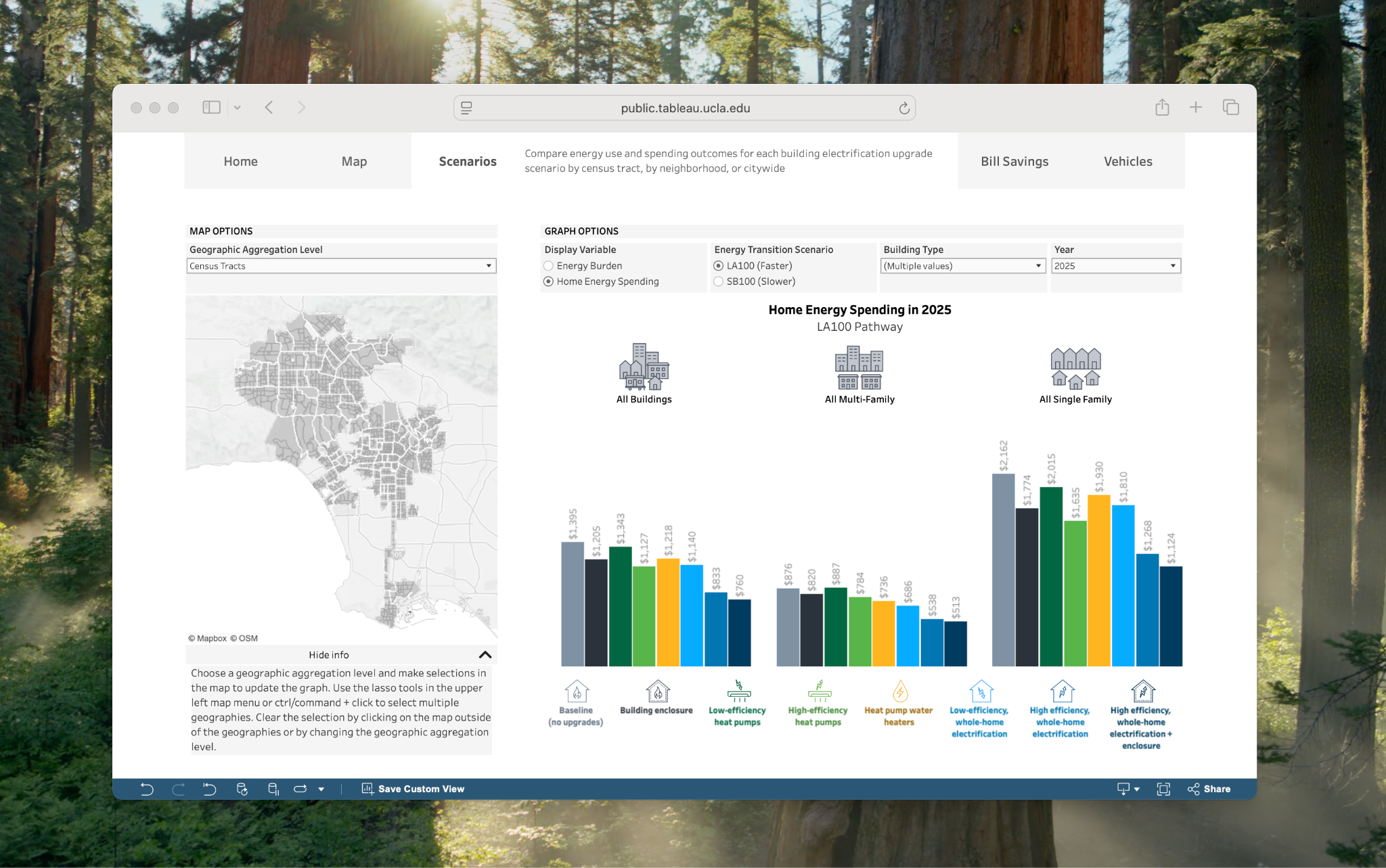
Screenshot of LA RESET Tool displaying household energy spending under different electrification scenarios in 2025
Last week, the LA Department of Water and Power (LADWP) released the LA100 Plan — the utility’s updated roadmap to achieving 100% carbon-free electricity by 2035. The plan draws on a wide range of modeling and analysis, including UCLA’s LA Residential Energy Transition (RESET) Tool, which projects how rising energy rates and home electrification will affect household energy bills across Los Angeles over the coming decades.
Now, UCLA researchers are making the LA RESET Tool publicly available through a new interactive online platform. Developed for LADWP by researchers at the California Center for Sustainable Communities and the UCLA Luskin Center for Innovation, the tool now allows residents, advocates, and policymakers to compare projected household energy spending under different electrification and utility rate scenarios through 2045.
Home electrification — transitioning from burning fossil fuels to using electric power — is a key part of reducing planet-warming carbon emissions. It also improves indoor air quality and helps keep homes cooler. However, it can involve high upfront costs, complex installation processes, and uncertainty about future utility bills. While replacing gas appliances with electric alternatives reduces or eliminates gas bills, some households worry that increased electricity use could drive up overall energy costs, especially if rates rise.

Low-income households and renters often face the greatest barriers to electrification and are most vulnerable to rising utility costs. We developed this new tool to help Angelenos understand where electrification could reduce bills and where additional support may be needed.
The LA RESET Tool combines data on households’ energy consumption, prices, and many other factors to estimate how electrification and future utility rates could affect household energy bills. The results show that most electrification upgrades are projected to reduce ongoing energy costs, while continuing to rely on gas appliances is generally more likely to increase household energy spending.
The California Center for Sustainable Communities at UCLA and the UCLA Luskin Center for Innovation are now publicly launching the L.A. RESET Tool via an interactive online mapping platform. The platform allows users to explore projected household energy use, spending, and savings across Los Angeles under a range of electrification and utility rate scenarios.
Users can compare:
The LA RESET Tool was developed by a UCLA research team led by Rachel Sheinberg. Julia Skrovan, a mapping and technology specialist at the California Center for Sustainable Communities, developed the online tool.
“People often worry that going electric will increase their energy bills. In LA, it’s often the other way around, because gas bills go down. These savings can help low-income households—if they get financial and logistical help to make the switch,” said Lauren Dunlap, a project manager of energy equity research at the Luskin Center for Innovation and LA RESET Tool collaborator.
Related research from the Luskin Center for Innovation and the California Center for Sustainable Communities includes:
Get our latest research in your inbox.
Online platform development:
L.A. RESET Tool development:
 How data centers are uniting Americans from across the partisan divide
UCLA’s Megan Mullin on the economic and political calculations surrounding AI growth
 Introducing new postdoctoral researcher, Rachel Sheinberg
Learn more about our new team member and her research
 Blueprint for a better planet
How Luskin Center for Innovation and other parts of UCLA are advancing a healthier, more sustainable future.

 New toolkit helps communities prepare for heat