July 16, 2026
ShadeLA advances lasting shade solutions for Los Angeles
In its first year, the coalition accelerated research, partnerships and policies for the World Cup and beyond

July 16, 2026
In its first year, the coalition accelerated research, partnerships and policies for the World Cup and beyond
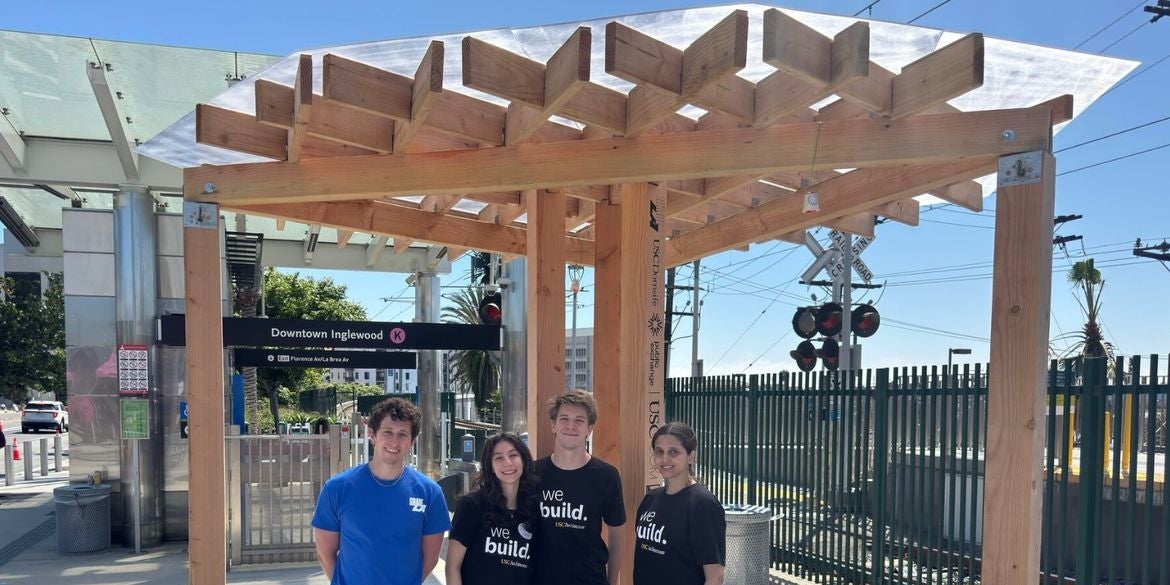
A student-designed shade structure debuted at the Downtown-Inglewood Metro station during the 2026 FIFA World Cup. (Credit: @SkyLovesAdventures)
Key Takeaways
By UCLA and USC
A year ago, USC Dornsife Public Exchange and UCLA Luskin Center for Innovation joined forces to launch ShadeLA to build a framework for a simple but ambitious vision: a future in which every Angeleno has access to shade where they live, work, play and gather. Today, the initiative has grown into a people-powered coalition of more than 30 public agencies, community organizations, nonprofits and academic institutions working together to expand both natural and built shade across Los Angeles County.
As Los Angeles welcomed the 2026 World Cup — and looks ahead to the 2027 Super Bowl and the 2028 Olympic and Paralympic Games — ShadeLA organizers at USC and UCLA recognized an important gap: While millions would gather outdoors for these events, shade was largely absent from confirmed event plans. ShadeLA didn’t stop at simply suggesting changes that could bring more shade; it took action via several pilots.
“The coalition’s temporary shade pilots are doing more than providing immediate relief,” said Kate Weber, executive director of USC Public Exchange. “They’re helping identify creative, effective strategies for planning, deploying and scaling shade for future mega-events while creating lasting benefits for the neighborhoods that host them.”
In just one year, ShadeLA has helped establish shade as essential public infrastructure for a hotter future.
Credit: @SkyLovesAdventures
Creating more shade at the scale Los Angeles needs requires unprecedented collaboration. Today, ShadeLA brings together the city of Los Angeles, Los Angeles County, LA Metro, Southern California Association of Governments and dozens of community partners to align planning, investment and implementation across the region. In its first year, that collaboration has already produced measurable results:

Building a cooler Los Angeles isn’t just about planting trees or installing shade structures. It’s about creating a culture where shade is treated as a civic resource and considered a fundamental part of healthy, equitable neighborhoods.
Policy and projects alone aren’t enough. Building a cooler Los Angeles also means building public understanding of why shade matters.
Throughout the past year, ShadeLA has engaged residents, designers, students and decision-makers around the idea that shade is more than comfort — it’s critical public infrastructure that supports health, mobility and community life.
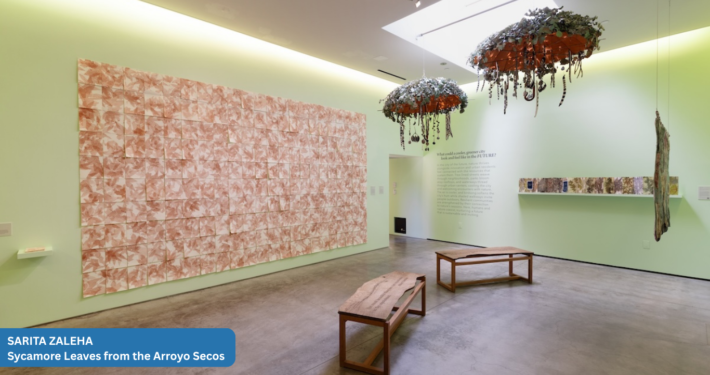
More than 100,000 people participated in the “Roots of Cool: A Celebration of Trees and Shade in a Warming World” education and art series at Descanso Gardens that UCLA’s Edith de Guzman co-curated.
And to bring these ideas into the real world, ShadeLA and its partners created two high-visibility pilot projects that showcased shade in action and reinforced how integral shade is to not only comfort, but also health and safety in public spaces. First, the inaugural Shade Zones design competition — created by the USC team, Dr. Bhavna Sharma, an Associate Professor in the USC School of Architecture, and LA Metro — challenged students across the LA area to come up with designs for temporary shade structures in transit spaces. Fifty teams from 17 universities submitted concepts, and the winning design debuted at the Downtown-Inglewood Metro station during the FIFA World Cup and then moved to the front of the California African American Museum in Exposition Park. It now sits on USC’s campus, where it will remain long-term.
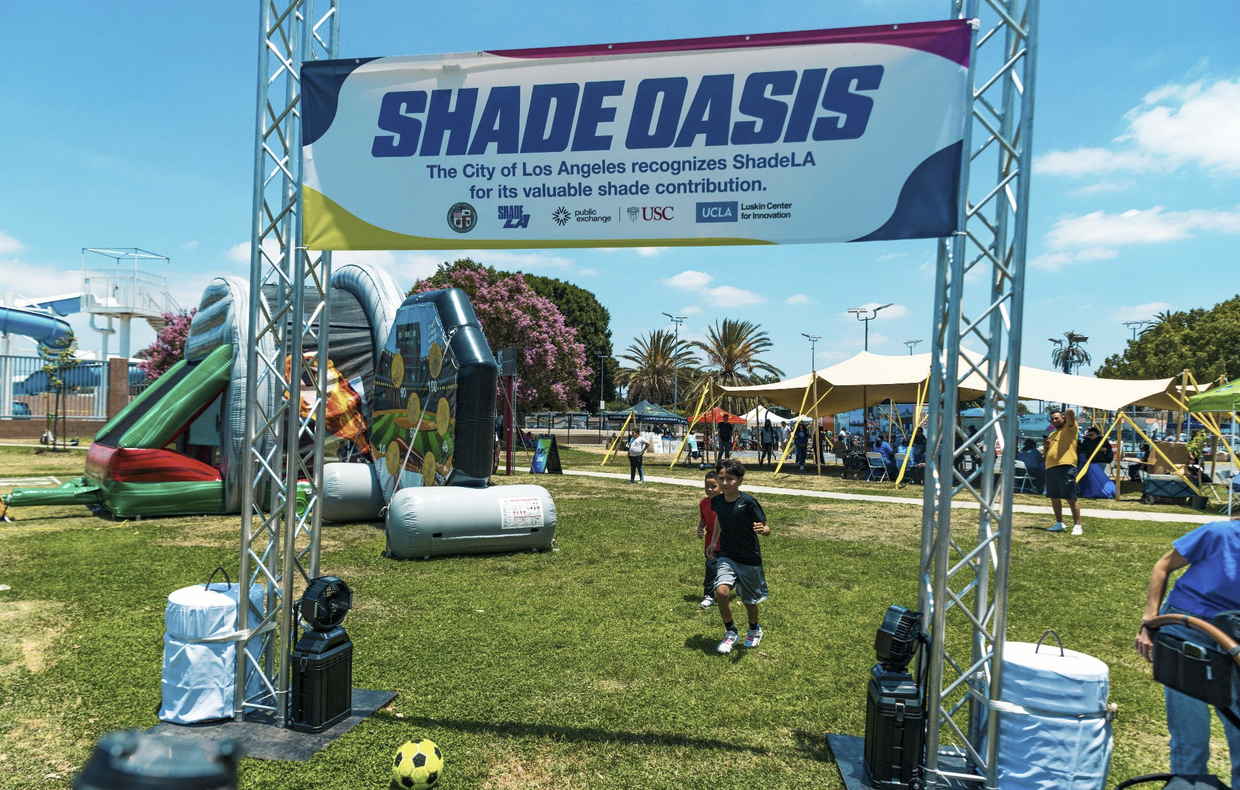
ShadeLA also debuted a temporary shade structure at a City of Los Angeles’ Kick It In the Park World Cup watch party in JT Harvard Park. Made possible by philanthropic partner Blue Shield of California, this installation demonstrated the simple but effective power of built shade by helping cool a space at the park by as much as 51 degrees.
In its second year, ShadeLA will continue to grow its coalition, advance research-driven policies that make shade easier to deliver, support projects in priority communities and help ensure that investments made ahead of the 2028 Games leave neighborhoods cooler and healthier long after the final whistle.
Organizations interested in joining the coalition can reach out to the team here.
Get our latest research in your inbox.
 What does it mean to be too hot, a TEDxUCLA talk
V. Kelly Turner explores how extreme heat is reshaping everyday life
 Descanso Gardens
A message of shade and hope
Descanso Gardens
A message of shade and hope
New research shows overwhelmingly positive outlook on climate action among visitors to tree- and shade-themed art exhibition
 ShadeLA offers a playbook to help city meet shade goals
New policy briefs outline how to streamline processes to increase shade in LA

 Descanso Gardens A message of shade and hope