
ABOUT THE COMMUNITY
The City of Pomona, located on the eastern edge of Los Angeles County, spans an area of nearly 23 square miles. It is situated in the Pomona Valley between the San Gabriel Valley and the Inland Empire.
The city is served and divided by four major freeways, namely Interstate 10 and State Routes 60, 57, and 71. These routes connect the city directly to San Bernardino, Orange, Los Angeles, and Riverside counties, enabling the city to serve as a critical transportation hub for the region.
Pomona is recognized as a highly diverse, majority-minority city in California, with a population of approximately 148,000 (U.S. Census Bureau, 2024)
The region’s racial and ethnic makeup includes approximately:
- 72% Hispanic
- 11% Asian
- 9% non-Hispanic White
- 6% Black
Pomona is recognized as one of the most polluted and vulnerable cities in the state.
Such inequities are the byproduct of numerous factors, including transportation-related pollution, a legacy of agricultural runoff, and the rise of industrial manufacturing, as well as industrial zoning regulations that have concentrated warehouses, logistics, and industrial facilities near residential areas.
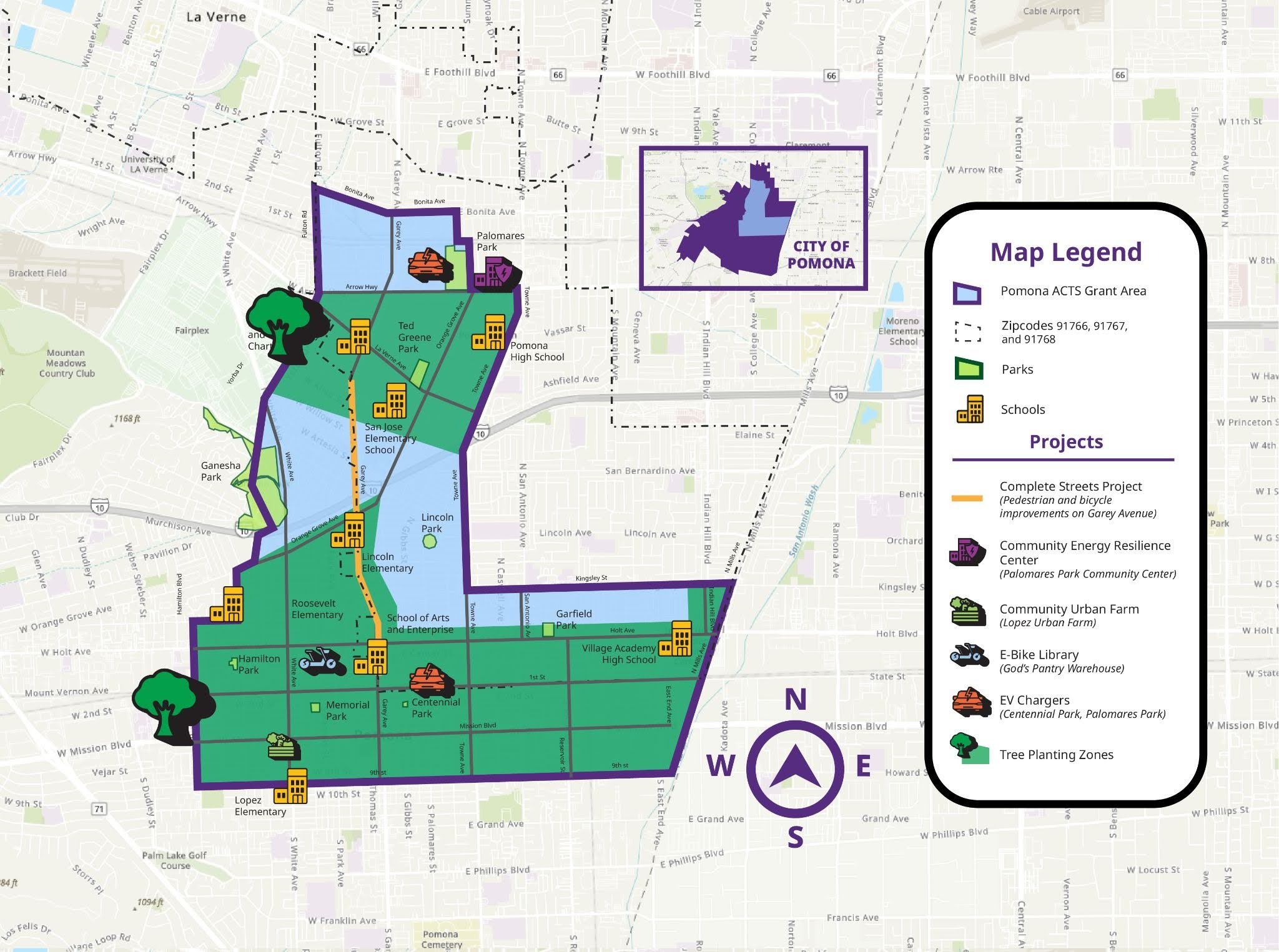
Pomona ACTS Project Area
The Pomona ACTS project area spans 5 square miles, concentrated around the city center and Garey Avenue — a major north-south arterial road in the city serving as a key commercial and commuter corridor. It is bisected by Interstate 10 and major regional rail lines to the north and south.
A Brief History of Pomona: The Legacy of Environmental Injustice
This section explores the history of Pomona and how past environmental injustices continue to affect its residents today.
From Gabrielino/Tongva Land to a Premier Agricultural Center
The first recorded inhabitants of the Pomona Valley were the Gabrielino/Tongva people; their 4,000-square-mile ancestral territory, known as Tovaangar, spanned the Greater Los Angeles Basin.1 Following the forced displacement of the Tongva people by Spanish missionization in the late 18th and early 19th centuries, the Pomona area transitioned into pastoral ranching under Mexican rule. The region later developed into a booming agricultural center for citrus and farming after the U.S. acquisition of California in 1848. The City of Pomona was officially incorporated in 1888. It has since evolved into a modern suburb and regional hub.2
Water availability, along with railroad access in the 1800s, further enabled the region’s ability to flourish as an agricultural center. By the 1920s, Pomona was known as the “Queen of the Citrus Belt,” boasting one of the highest per-capita levels of income in the U.S.3
However, decades of agricultural activity in the region, particularly citrus farming, led to significant groundwater contamination, primarily from the use of Chilean nitrate fertilizer containing perchlorate — a chemical that disrupts thyroid function and poses significant developmental hazards.4,5 This finding ultimately precipitated a 10-year legal battle between the city and fertilizer suppliers that sold the fertilizer to citrus farmers for decades. While the citrus industry is no longer the primary economic driver of the region, the City of Pomona continues to manage the long-term effects of perchlorate in its groundwater.6,7
1 https://nahc.ca.gov/cp/tribal-atlas-pages/gabrielino-tongva-nation/
2 https://claremontheritage.org/gabrielino_tongva.html
3 https://en.wikipedia.org/wiki/Pomona,_California
4 https://wwwn.cdc.gov/TSP/PHS/PHS.aspx?phsid=892&toxid=181
5 https://www.dailybulletin.com/2021/09/10/pomona-wins-48-million-in-groundwater-pollution-case/
6 https://www.waterboards.ca.gov/rwqcb4/water_issues/programs/remediation/perchlorate/perchlorate%20report.pdf
7 https://www.pomonaca.gov/government/departments/water-resources-department/water-supply
Transition to an Industrial Hub
The City of Pomona today functions as a critical industrial and manufacturing hub due to its location at the intersection of major transportation routes, acting as a gateway between Los Angeles County and the Inland Empire. It serves as a key entry point to the Inland Empire logistics corridor — the largest in the U.S.8
Notably, low-income communities located along major transportation routes have disproportionately borne the burden of diesel freight pollution. In particular, residents in Pomona’s industrial zone continue to deal with pollution associated with the growing goods movement industry, as well as the high concentration of waste and recycling facilities.9,10 Today, all census tracts within the Pomona ACTS project area rank above the 76th percentile in CalEnviroScreen. This means they are among the top 76% of communities in California with the highest pollution burden and vulnerability to environmental pollutants and their effects.11
8 https://scag.ca.gov/sites/default/files/2025-05/Addendum%20to%20Business-Report_May%202025_0.pdf
9 https://lapublicpress.org/2024/02/after-decades-of-environmental-issues-pomona-is-updating-its-zoning-code/
10 https://calepa.ca.gov/wp-content/uploads/2018/09/Pomona_EJ_Initiative_FINALweb.pdf
11 https://oehha.ca.gov/calenviroscreen/report/draft-calenviroscreen-50
Structural Racism and Land Use Policies
The city’s historic zoning and land use policies have also contributed to residents’ pollution burden and their demand for environmental justice reforms. Until recently, warehouses in the city were governed by the original 1949 zoning code, which enabled the rapid and at times unchecked development of logistics facilities near homes.
Today, Pomona’s industrial corridor and its surrounding neighborhoods, located in the southeastern corner of the city, rank as one of the state’s most polluted areas.12 Air quality issues are significantly exacerbated by the increase in local warehouse development, a pattern mirroring the region’s broader logistics boom.13
12 https://storymaps.arcgis.com/stories/5f2b38658c244cf0bb8838afc949bf5d
13 https://lapublicpress.org/2024/02/after-decades-of-environmental-issues-pomona-is-updating-its-zoning-code/
Community Resistance and Policy Reform
Collectively, the issues posed by the city’s industrial zoning and land use policies ultimately spurred the city council to issue a temporary moratorium on warehouse construction in 2022.14,15
Decades of environmental issues related to the original 1949 zoning code ultimately contributed to the city’s decision to comprehensively update the code in 2024.16 Key foci include addressing the negative impacts associated with diesel trucks, as well as noise and air pollution, and targeting stricter oversight of industrial developments near residential areas.17,18
14 https://lapublicpress.org/2024/02/after-decades-of-environmental-issues-pomona-is-updating-its-zoning-code/
15 https://www.dailybulletin.com/2022/06/15/pomona-considers-45-day-moratorium-on-new-warehouses/#:~:text=Without%20any%20regulations%20put%20in,any%20new%20trucking%20facilities%20citywide.
16 https://www.pomonaca.gov/government/departments/development-services/planning-division/zoning-and-development-code
17 https://lapublicpress.org/2024/02/after-decades-of-environmental-issues-pomona-is-updating-its-zoning-code/
18 https://www.pomonaca.gov/home/showpublisheddocument/7803/638827305310670000
Local leaders win a $20 million TCC grant to address persistent inequities in Pomona.
Top page photo:
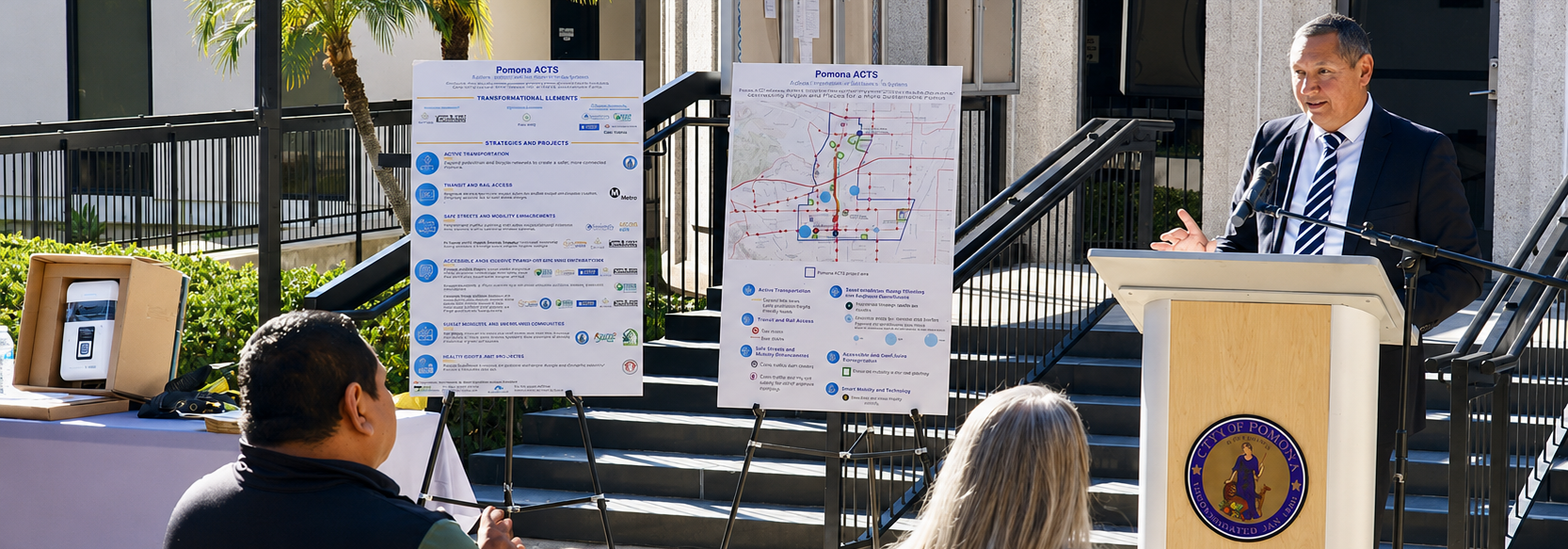
City of Pomona Mayor Tim Sandoval speaking at the Pomona ACTS grant award announcement, January 2024
Credit: The Energy Coalition