
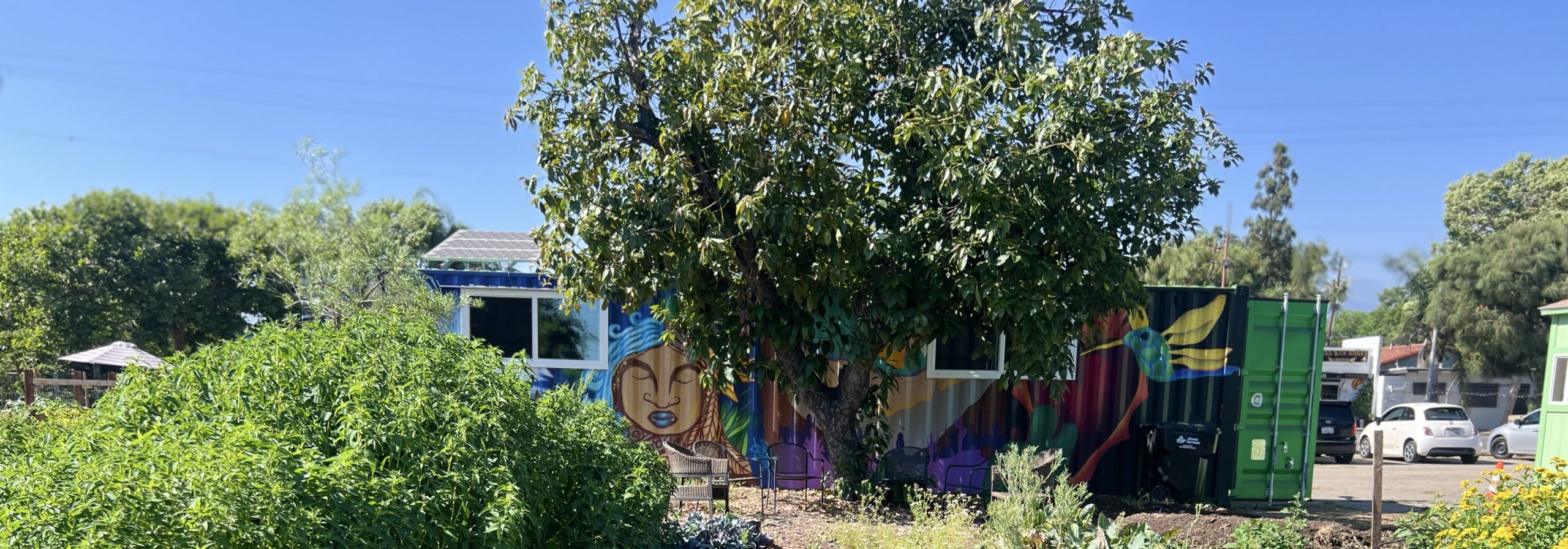
Urban farm sows health, well-being, and community connections
BACKGROUND
This case study explores how TCC-funded improvements at local community farms are strengthening access to healthy food, green spaces, and cultural programming, while also fostering professional and personal growth opportunities for residents. The case study highlights the collective stories of Alicia Valle and Peter Lechuga, two residents involved with volunteer efforts at Lopez Urban Farm, a community farm and wellness project in Pomona, CA.
For more on the TCC-funded efforts at Lopez Urban Farm, click here.
Interviews for this case study were conducted in January 2026.
ALICIA VALLE moved to Pomona nearly 14 years ago. She and her family have called the city home ever since. In 2021, amid the widespread social isolation induced by the COVID pandemic, Valle was in search of a sense of community. Specifically, Valle searched for something in the spirit of a “third space,” a sociological concept describing a social environment distinct from home or work that fosters community, social interaction, and mental well-being.
It was in this search that Valle first heard about Lopez Urban Farm. She subsequently decided to attend a crochet class offered as part of the farm’s weekly night market event, El Puestecito. “Right away, I was in love with the farm and everything they were doing,” Valle recalls. Once she began visiting more regularly, Valle asked how she could get further involved. This led to the farm providing her with space to start a volunteer butterfly garden project, which would eventually become a foundational part of the farm — the Lopez Urban Farm Butterfly Garden.
For Valle, this project became an opportunity to nurture a deep passion for bringing butterfly gardening to urban spaces. In doing so, it became a way for her to engage residents of all ages and foster a passion for environmental and social justice.
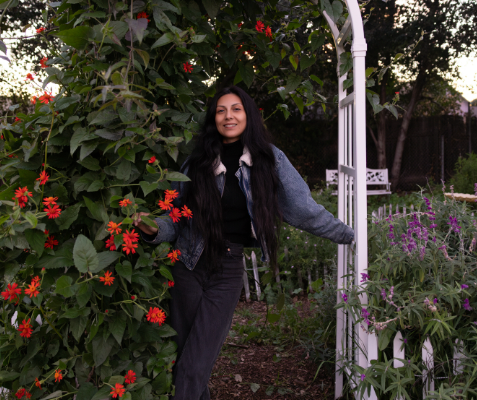

[Regarding the butterfly garden] in my head I was like, ‘If you can just teach someone something so simple — like caterpillars and butterflies and what they need to thrive — [that] can kind of spark something in someone that will lead to bigger actions.’
Through her experience, Valle has also witnessed the impact that TCC-funded efforts have had on the farm and its ability to support the local community. She shares how such efforts — from installing electricity and expanding the farming area by half an acre to installing a refrigeration system that has extended the shelf life of harvested crops — have had a notable impact on the farm’s offerings and benefits to residents.
Valle also recognizes the impact that the farm’s guiding principles have had on her, both personally and professionally. In particular, she highlights the alternative economic model that the farm embodies, one based on mutual aid and shared abundance and underscored by the principle of “take what you need, pay what you can.” For Valle, this idea has impacted her worldview and, more concretely, inspired her to approach her professional work as a photographer similarly. She now uses a sliding scale for her clients and encourages them to pay what they can, in whatever form they can.
Every time I go [to the farm], there is something new that was needed … being able to have the refrigeration [installed] because harvesting fresh food, right after, it goes bad if it’s not refrigerated properly, even from one night to the other. So that’s really nice.
Seeing the way Lopez [Urban Farm] runs the ‘take what you need, pay what you can’ system has really changed the way I view my business.
Valle also aspires to build on the skills and the confidence she’s gained through her volunteer work at the farm. Specifically, she hopes to get involved with the local school district to teach kids about farming and gardening in partnership with the farm. More broadly, she hopes that Lopez Urban Farm can serve as a model for similar communities.
For Valle, Lopez Urban Farm is a space that embodies acceptance and community at its core. From the skate park that the farm constructed and that her children enjoy, the farm-fresh produce that her family relishes, to the farm’s care for the unhoused community, it has become that third space for which Valle searched — one that she will continue to advocate for and protect.
PETER LECHUGA is a recent Pomona transplant, having moved here three years ago to be with his fiancée, who is a lifelong Pomona resident.
A professional poet, writer, and editor, Lechuga first became involved with Lopez Urban Farm in late 2023 after being invited to attend a writing workshop at the farm hosted by the poet laureate of Pomona. From there, his involvement grew exponentially. Lechuga began organizing events and serving as the editor of the ILL Poetry Anthology — a collection of poems, photography, and artwork honoring the life and legacy of civil rights leader Ignacio Lopez, for whom the farm is named.
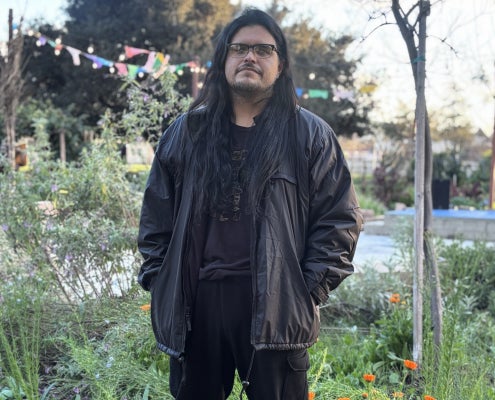
Currently, Lechuga runs the weekly writing workshops and helps organize art and other literary events at the farm. Through these volunteer efforts, he has noticed the impact of the TCC-funded work — including the addition of lighting — which has made the farm’s evening programming more accessible to the community.
We’re so happy about … all the electricity throughout the farm because it used to be so dark at night. … [The lights have been] such a positive change and a quality-of-life improvement that we’re all happy with. … It’s completely impacted the community there.
In addition to going to the farm to nurture his professional passions, Lechuga felt drawn by the farm’s mission. “[The farm’s] work, their dedication to mutual aid, it’s astounding. And I feel that we have the same respect for knowledge and the land. That was immediately something that drew me into [the] work they perform and do.”
Volunteering at the farm has also had an impact on Lechuga personally. As a vegan, eating healthy is important to him. Lechuga is grateful for the opportunity to harvest his own locally grown produce and notes the financial savings that he’s experienced from the farm’s pay-what-you-can system, as well as the positive impacts on his overall well-being.
Lechuga has also learned skills from volunteering that he now uses regularly in his own life, including composting and gardening. He and his fiancée put those skills to use growing crops, including fruit trees, in their own backyard, sharing any excess with community members at the farm.
Having the opportunity to harvest my own organic crops that aren’t produced on a factory farm … just [having] clean food so often has just been absolutely beneficial to me and my fiancée’s life.
[The farm has] taught me organization skills; it’s taught me the true strength of community, and that if you give, the community will always give back, that [community] is a support system … I feel like nothing is more powerful than seeing a community united together, sharing the same ideas, and just wanting to build. And I learned that at the farm.
For Lechuga, everything that he’s done with Lopez Urban Farm has changed his life on both a personal and a community level. He describes how the farm helped him become an effective grassroots organizer and shares how he recently used those skills to organize a poetry event protesting the immigration raids in Downtown Los Angeles. The connection between his personal values and his community engagement is something that he hopes to continue nurturing.
Top page photo:
Lopez Urban Farm, a TCC-funded partner organization in Pomona, CA
Credit: The Energy Coalition